

By Petra Williams | Eye on the Economy
November 20, 2026 – Antigua and Barbuda had no seat at the table. Yet the matters discussed in Shenzhen- peace, petroleum supplies, and relations between major powers- can reach directly into Caribbean households, businesses, and government budgets.
Chinese President Xi Jinping chaired the summit with United States President Donald Trump and Russian President Vladimir Putin on Thursday, November 19.
While the leaders talked, the United States’ war on Iran and Russia’s war on Ukraine raged on. Both conflicts have inflicted economic hardship far beyond their battlefields. For small Caribbean states, the consequences include higher import costs, pressure on public finances and uncertainty surrounding tourism and investment.
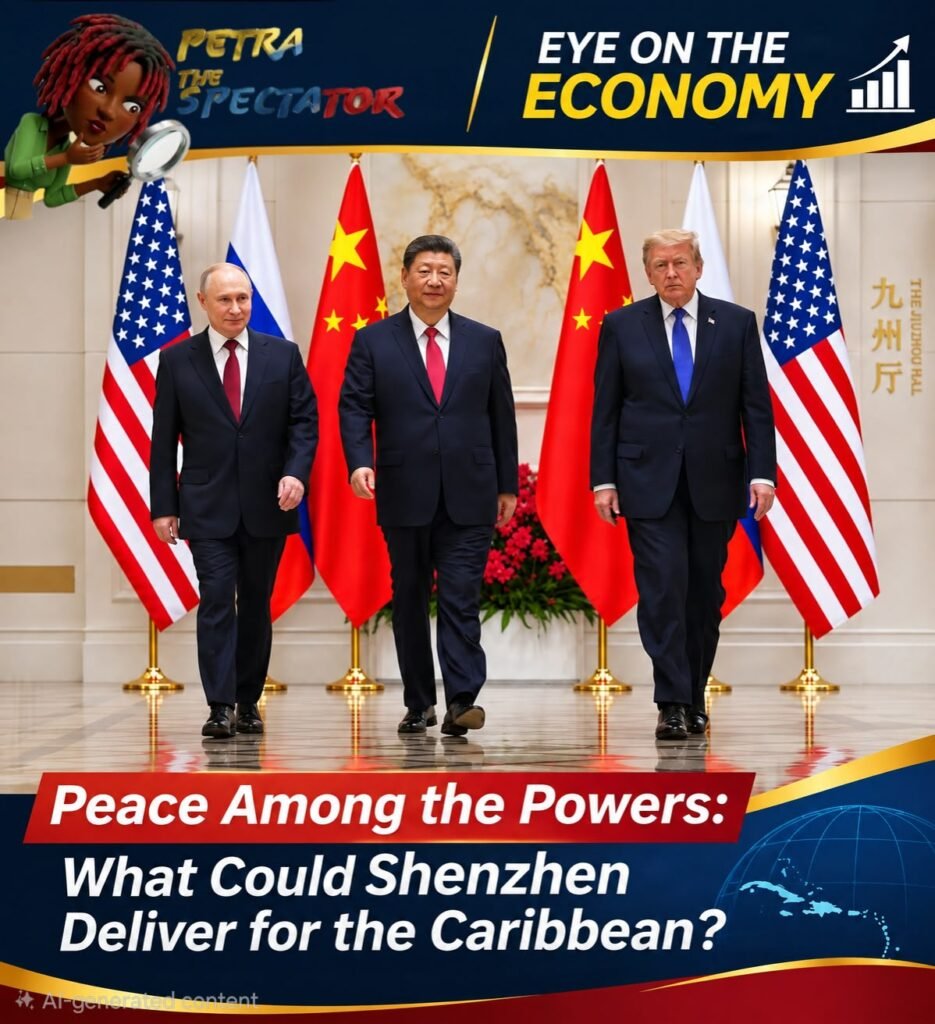
Held as leaders gathered in Shenzhen for APEC meetings, the trilateral encounter was a separate three-country initiative, rather than an agreement adopted by the wider Asia-Pacific Economic Cooperation membership.
Antigua and Barbuda is not among APEC’s 21 member economies, but membership is hardly a prerequisite for feeling the consequences of decisions taken by its largest powers. The potential gains for countries outside the forum would come mainly through more dependable energy supplies, fewer disruptions to commerce and a more stable environment for travel and investment.
Xi framed the encounter’s wider significance in terms that resonate beyond the three countries: “peace among major countries brings stability to the world.” Putin’s remarks brought the economic connection into focus. According to China’s official summit readout, he expressed Russia’s willingness to promote open international trade and “safeguard energy and food security”, two areas of immediate concern for Caribbean countries exposed to imported inflation. Trump also stressed engagement. The official summit readout credits him with saying: “Maintaining stability and achieving peace require dialogue.”
For countries such as Antigua and Barbuda, the practical test is whether that dialogue produces more predictable economic conditions.
This first summit together concluded with a Declaration toward Peace. It sets out four areas of agreement: United Nations reform; plans to increase the production and supply of refined petroleum products; a position on state consent, officials’ immunities and international courts; and dialogue to reduce nuclear risks and prevent proliferation.
Its petroleum provision is the clearest potential economic opening for Caribbean fuel importers. Refined products include the fuels that power vehicles, aircraft and much of the region’s electricity generation. If additional supplies reach international markets, they could ease shortages or price pressures, especially with reliable shipping and fewer disruptions.
For Antigua and Barbuda, that possibility matters. Higher imported fuel costs have pressured public finances, with the government forgoing consumption tax revenue to cushion consumers from the full increase. Expanded concessions on vehicles and parts for bus operators have also meant revenue forgone, intended to contain operating costs and ease pressure for higher fares. Meanwhile, rising international prices have added to domestic inflationary pressures, while global uncertainty risks affecting both visitor travel and expenditure.
As we approach the Budget Presentation and the related debates in a few weeks, any meaningful improvement in energy prices and international stability could strengthen the government’s fiscal outlook. Lower import costs could ease pressure on households and businesses while reducing the need for revenue concessions, creating more favourable conditions for planning and implementation in the year ahead.
But a declaration is not a price reduction.
The official summit readout, and all post-summit media releases, specify no production volumes, delivery timetable, allocation for small states, or mechanism to ensure that additional supplies reach vulnerable importers. Nor does it announce changes to sanctions or other restrictions affecting energy trade.
Even if international fuel costs fall, the effect on an Antiguan electricity bill or pump price would depend on purchasing arrangements, freight, inventories, taxes and domestic pricing mechanisms. The practical benefit rests on those reductions reaching consumers. And then, there is the matter of government recouping consumption tax previously foregone as part of the earlier subsidy at the pump.
The Caribbean would also experience the effects unevenly. Fuel-importing economies could welcome lower costs, while petroleum-producing countries would have to weigh consumer relief against possible reductions in export earnings.
Tourism offers another potential channel. Reduced international tension could support traveller confidence and make airline operations more predictable. More stable aviation fuel costs could help, although cheaper tickets would remain a commercial decision. The summit itself guarantees neither additional flights nor visitor arrivals.
Unresolved Matters
The declaration is also significant for what it leaves unresolved.
Although the summit discussions addressed Ukraine and the Middle East, the published agreement announces no ceasefire, settlement or specific timetable for ending the wars identified at the outset. The leaders’ commitments to dialogue must therefore be assessed against their ability to resolve conflicts in which their own countries are directly involved.
The political implications deserve equal attention. For small states, respect for sovereignty and peaceful dispute resolution are essential protections. Cooperation among powerful countries can reduce the danger of confrontation. However, agreements among those powers must also respect the rights and security of countries absent from their discussions.
The declaration’s approach to international courts therefore warrants scrutiny alongside its peace commitments. Its emphasis on state consent and officials’ immunities raises a legitimate question: how will those principles be balanced with accountability for serious international crimes? Similarly, UN reform would serve small states best if it strengthened their voice and access to justice.
For CARICOM and the OECS, the operational details are key: what additional fuel supplies are envisaged, when might they materialise, and how could smaller markets benefit? Regional governments would be served to keep an eye for opportunities to press for inclusive UN reform while continuing work on renewable energy and resilience at home.
Shenzhen has produced a statement of intent. For Antigua and Barbuda and the Caribbean, its worth will be measured in more dependable supplies, manageable costs, and greater room to plan for development, alongside international rules that protect the right of small nations to shape their own future.