

The Economics, the Choices, and the Conversation Behind EC$16.50
by Petra Williams
When the price of gasoline moved from EC$14.50 to EC$16.50 per imperial gallon on September 1, the number at the pump naturally attracted attention.
But the increase should not have come as a complete surprise.

Antigua and Barbuda does not operate in an economic bubble. We import the fuel we consume, and movements in international petroleum prices and other external costs eventually filter into the domestic price structure.
For an extended period, consumers have been shielded from the full impact of those movements, with the Government effectively using the consumption tax component of the fuel price build-up to cushion what reached the pump. That policy choice comes at a fiscal cost.
The useful conversation surrounding the recent increase is not only why the price changed, but what actually makes up that EC$16.50 and how those components ripple across the economy.
To understand that, we have to travel backward from the pump to the US Gulf Coast. The September 1 price is best understood not as a single Government decision or company charge, but as a sequence: the international product cost, the cost of landing the fuel, Government taxes, WIOC components, transportation and, finally, the dealer’s margin.
The Price Starts in the Gulf
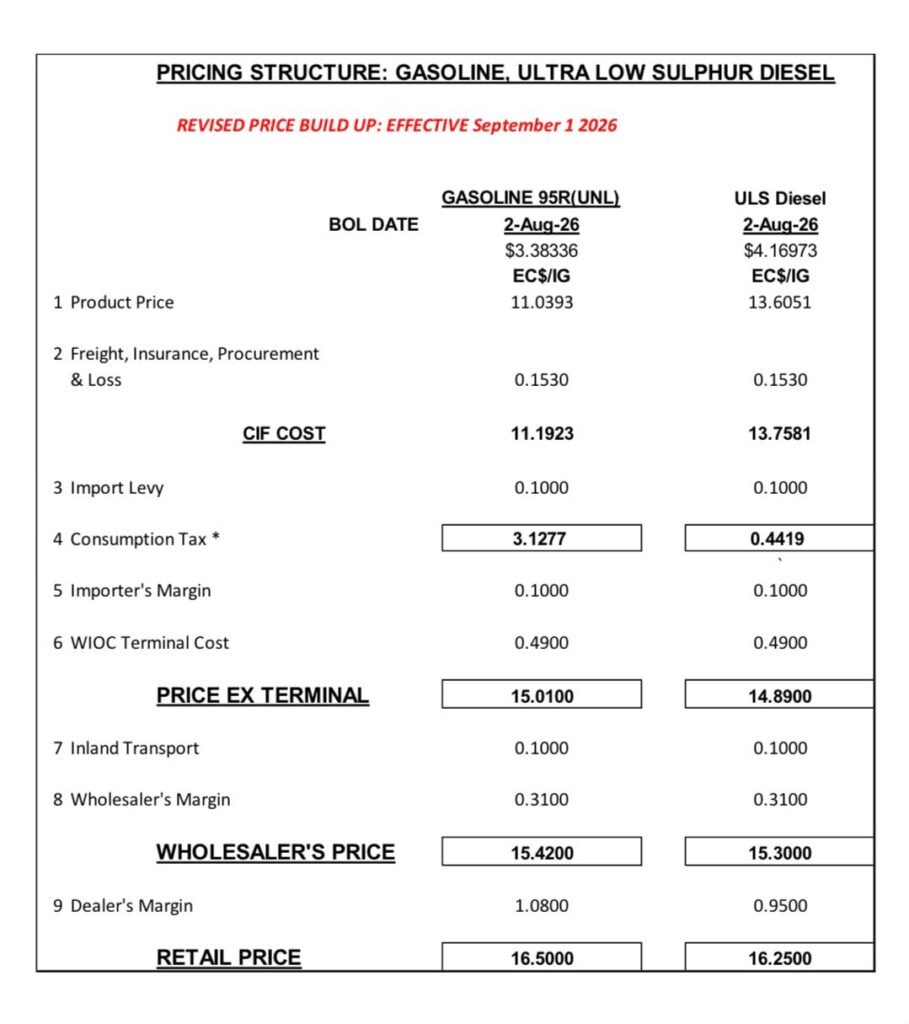
The official Revised Price Build Up, issued by the Ministry of Finance and Corporate Governance effective September 1, provides an opportunity to follow that EC$16.50 backward, line by line.
In an interview on Morning with Sly J shortly after the latest price adjustment, West Indies Oil Company Chief Executive Officer Gregory Georges walked us through the adjustment mechanism.
The gasoline in the September 1 build-up carries a Bill of Lading date of August 2, the date the product was loaded on the US Gulf Coast and the date used to determine the applicable international purchase price.
The official build-up records the gasoline purchase price at US$3.38336 per US gallon. Georges explained that the US dollar price must then be converted to Eastern Caribbean dollars and the US gallon converted to an imperial gallon, yielding a product price of EC$11.0393 per imperial gallon.
From the Ship to Antigua
The next component is 15.3 cents per imperial gallon for freight, insurance, procurement and loss, for a landed cost of EC$11.1923 per imperial gallon.
Georges added an important dimension to those numbers: timing. Fuel loaded in the Gulf does not arrive at an Antigua and Barbuda service station the following morning. He explained that a shipment can take roughly two weeks to reach Antigua and then enters WIOC’s storage system while existing inventory is being consumed.
It means that the fuel we purchase at the pump today was likely purchased several weeks earlier.
Then Government Enters the Equation
Once the product reaches its CIF cost, domestic components are added: a 10-cent import levy per imperial gallon and the much larger variable, consumption tax.
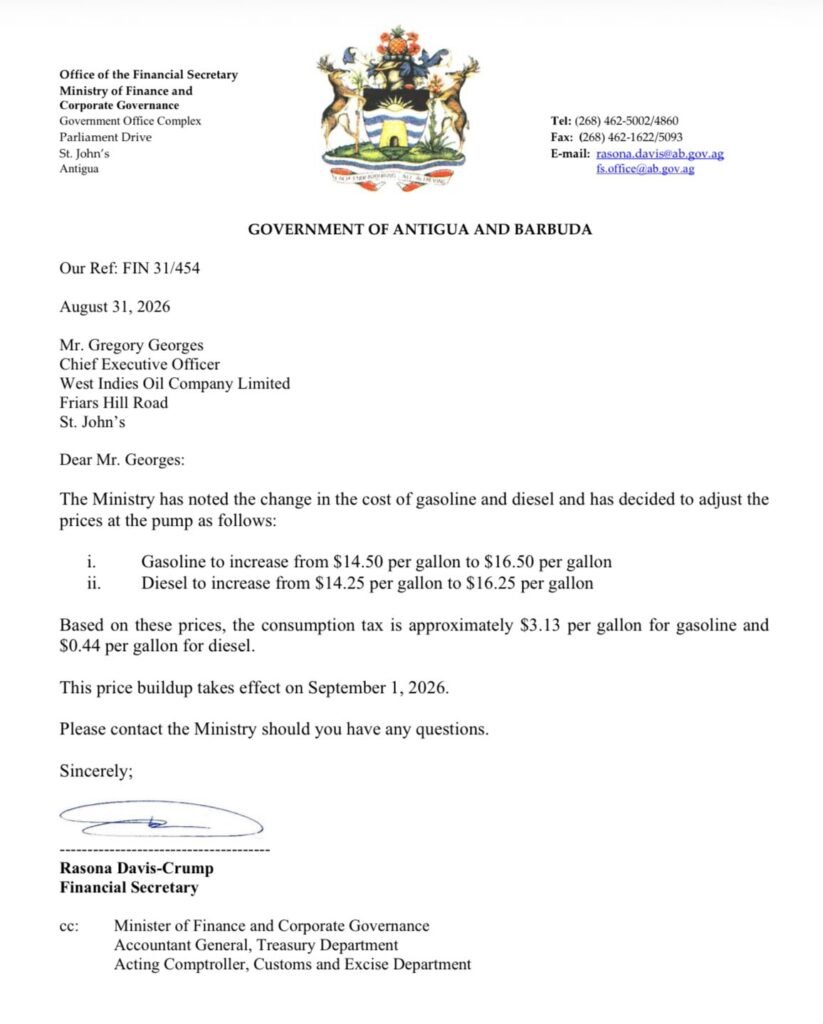
In her August 31 letter to WIOC Chief Executive Officer Gregory Georges, Financial Secretary Rasona Davis-Crump indicated that the consumption tax would be approximately EC$3.13 per gallon for gasoline and EC$0.44 per gallon for diesel.
This is where understanding the latest increase matters. Georges described consumption tax as the “plug number” in the build-up. “That’s government policy right there,” he explained. “They determine this variable, the two variables here, the consumption tax and the price of the pump.”
He continued by explaining how changes at the pump affect the tax calculation: “If you increase the price at the pump, then obviously you’re going to increase the tax. If you drop your price at the pump, you’re going to drop your tax.”
Returning to the September 1 calculation, Georges was even more specific: “And the plug number is the consumption tax, 3.127. So that’s what the government is getting out of this now after the increase in price. If they didn’t increase the price, they’ll be getting $2 less [per gallon].”
In other words, the consumption-tax component is where the Government’s policy choice becomes visible in the price build-up. Holding the previous pump price would not have made the higher underlying cost disappear. According to Georges’s explanation, it would instead have meant the Government collecting roughly EC$2 less per imperial gallon in consumption tax.
What Does WIOC Actually Get?
The official breakdown identifies three principal components associated with WIOC: an importer’s margin of 10 cents per imperial gallon, a terminal cost of 49 cents, and a wholesaler’s margin of 31 cents, totaling 90 cents per imperial gallon.
Georges was quite direct about what the 49-cent terminal component represents, noting that it has not changed since the 1980s: “That’s what we get. And that’s to run our business. I mean, we have salaries to pay, we got wages, we got professional fees, got repairs and maintenance. We got to obviously [fund] our CAPEX programme. We got to invest in our facilities, health and safety.”
He added that the “cost of running the terminal… has increased several times since then,” and argued: “We need to review some of these numbers here. There’s no question.”
Georges’s argument, then, is that while the underlying cost of the product has moved considerably over time, these particular components have not. Naturally, when he suggested they should be reviewed, your economist offered a slightly different interpretation of “review”: downward.
We agreed to disagree.
The Last Miles to the Pump
Once the fuel leaves the WIOC terminal, the official build-up provides 10 cents per imperial gallon for inland transport. Third-party contractors provide this service under WIOC branding.
There is another economic wrinkle here. The trucks themselves consume fuel. So when fuel and other operating expenses rise, the contractors’ costs can rise while the transport component remains fixed.
Add WIOC’s 31-cent wholesaler’s margin and the official wholesaler’s price becomes EC$15.42 per imperial gallon.
Then there is the dealer’s margin, fixed at EC$1.08.
And there it is, the final price to the consumer: EC$16.50 at the pump.
One Price, Many Hands
Strip away the mystery of EC$16.50 and the gallon begins to tell its own story. The landed product cost is approximately EC$11.19. Government components: 10-cent import levy and consumption tax. WIOC’s importer and wholesaler margins are 10 cents and 31 cents respectively, while its terminal cost is 49 cents. Inland transportation adds another 10 cents, and the dealer’s margin is EC$1.08.
What consumers experience as one price is therefore really a stack of costs, taxes, allowances and margins.
Once we understand that stack, the national conversation becomes more interesting. When the underlying cost of fuel rises, somebody must absorb the movement. Does Government surrender some consumption-tax revenue? Does WIOC operate within longstanding fixed components despite rising costs? Do transporters or dealers keep operating on fixed margins while expenses rise? Or does the consumer pay more at the pump?
No column in the spreadsheet disappears and gets marked “somebody else.” Every dollar has to land somewhere.
Beyond $16.50
Not that we need reminding, but Antigua and Barbuda is a small, open and import-dependent economy. Events thousands of miles away can alter what we pay for fuel, food and other essential goods. We cannot control international petroleum markets. What we can control is how we respond.
Government can determine how much revenue it is prepared to forego to cushion consumers and how much of the underlying cost ultimately reaches the pump.
This fuel price increase occurred during a period in which Government expenditure continues to expand, including employment, social programmes and the provision of other public goods and services. At the same time, Government revenues increased significantly in other areas, particularly Customs revenues, and any balanced assessment of the country’s fiscal position must account for this.
But stronger revenue performance elsewhere does not make foregone fuel revenue irrelevant. Money foregone remains unavailable for another purpose. Eventually, the Government had a choice: continue cushioning consumers through the consumption-tax component or collect more of that revenue and let the retail price move.
For those of us who may argue that Government should continue holding down the price of fuel, we must be prepared to answer the next question: at what cost? Should Government continue surrendering consumption-tax revenue? If so, what revenue replaces it? What expenditure should be reduced or deferred? Should Government borrow instead? There is no magic money.
Equally, Government cannot simply point to international conditions and consider the discussion closed. External circumstances may create the problem, but domestic policy determines how that burden is ultimately distributed among the Treasury, businesses and households.
Government must also bring affected stakeholders into the conversation. Not because consultation gives any group a veto over public policy, but because meaningful engagement allows businesses and consumers to understand, prepare for, and respond to decisions shaped by external conditions over which Antigua and Barbuda has limited control.
That is where accountability belongs.
So perhaps the most useful outcome of the September 1 increase would be a better national understanding of what EC$16.50 actually represents and the establishment of a platform for dialogue with all stakeholders.
Long before the attendant pumps EC$100 worth of gasoline into your vehicle, the economics of that gallon have already traveled from the Gulf Coast to the high seas, through WIOC’s tanks, into the Treasury, onto a haulage truck, and through the service station. The pump is simply where we finally meet the bill.
But how that bill is divided, how those decisions are made, and how well the country is included in the conversation are matters that deserve our attention long after the tank is full.
And that is worth keeping an Eye on the Economy.