
The 18th BRICS Summit held September 12 – 13, 2026, brought together an expanded grouping whose membership represents nearly half of the world’s population and approximately 40 percent of global GDP. Beyond the numbers, the conversations in New Delhi revealed something more consequential: the Global South is looking to impact the rules and power base of the world order.
Chinese President Xi Jinping placed the moment within a changing global landscape. He said, “The world is undergoing accelerated transformation unseen in a century,” pointing to a Global South is rapidly growing in strength and moving toward a multipolar world he described as “unstoppable.”
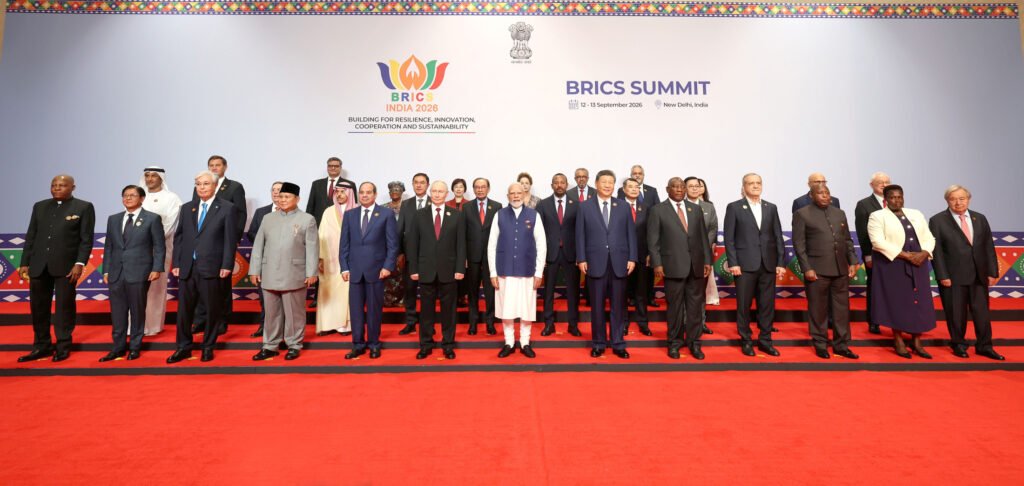
India’s Prime Minister Narendra Modi approached the same question from a different angle. He described BRICS as reaching a “coming of age” moment and argued that developing countries should no longer simply accept rules created elsewhere. In Modi’s formulation, the Global South must become a “rule-shaper.” Modi also pushed back against the idea that BRICS is anti-Western. “BRICS is not against anyone,” he said, while arguing for a larger role for developing countries in global governance.
Those two ideas deserve to be considered together. This is not necessarily a conversation about replacing one global power with another. It is increasingly a conversation about whether the international table itself can become larger, expanding to include countries historically seated around its edges.
For the Caribbean, that is not an academic question. Whether the issue is climate finance, debt, trade, correspondent banking, artificial intelligence, development financing or the reform of international institutions, small states know very well what it means to live with decisions made in rooms where their voices carry considerably less weight. The question, therefore, is not simply whether BRICS is becoming more powerful. It is whether this changing distribution of global power creates greater space for countries such as ours.
What is BRICS?
BRICS began in 2006 as BRIC, bringing together Brazil, Russia, India and China. South Africa joined four years later, adding the “S” and giving the grouping the name by which it is now known. It has since expanded to include Egypt, Ethiopia, Iran, the United Arab Emirates, Saudi Arabia and Indonesia. The 11 members now make up nearly half of the world’s population and account for about 40 percent of global gross domestic product.
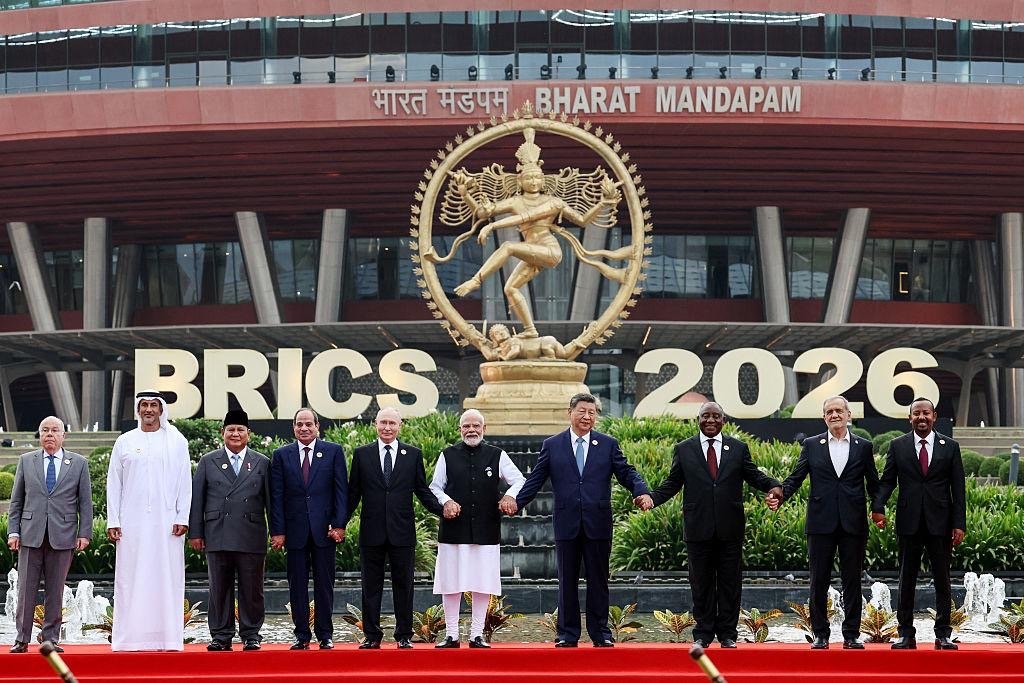
That economic and demographic weight gives the grouping increasing significance. BRICS has long sought greater influence for developing economies within institutions traditionally dominated by Western powers. It has pushed for reform of bodies including the World Bank, the International Monetary Fund, and the World Trade Organization.
The New Delhi Summit suggested this ambition is broadening. BRICS wants greater representation within the existing architecture, and a stronger role for the Global South in determining how that architecture evolves.
From Rule-Takers to Rule-Shapers
This may be the most important message for the Caribbean. For decades, developing countries have argued that leadership and decision-making in international institutions do not adequately reflect the distribution of population, economic activity, vulnerability, or development needs worldwide. Modi’s “rule-shaper” formulation puts that frustration into remarkably simple language: the Global South should not merely receive rules; it should help create them.
Xi expressed the same broad ambition differently, calling on BRICS countries to “firmly stand on the right side of history” and become pioneers in innovative development, maintain peace and stability, facilitate mutual learning between civilizations, and reform and improve global governance. He argued that BRICS countries should help steer the international order toward “greater justice and equity” while working toward a “community with a shared future for humanity.”
There are ideological and geopolitical layers to those formulations, of course. But beneath them sits a straightforward question with particular relevance for developing countries: Who gets a meaningful voice when the international rules are written?
Why Rules Matter Particularly to Small States
Modi explicitly rejected the notion that BRICS should be viewed through the prism of geopolitical rivalry, often framed as China and Russia on one side and the United States and its Western allies on the other. Modi stated, “BRICS is not against anyone,” a distinction that matters enormously for the Caribbean.
The Caribbean interests are not served by replacing dependence on one powerful centre with another. The region should not approach international relations as geopolitical fandom, choosing teams and defending colors. Small states require something considerably more sophisticated. We need relationships that expand our room to manoeuvre.
A genuinely multipolar world could provide more sources of investment, technology, development finance, markets and diplomatic partnerships. It could also give developing countries greater leverage when negotiating the terms on which those relationships are built. But multipolarity carries risks too. More powerful centres can mean more choices and greater pressure to choose.
Xi’s emphasis on the international order is especially relevant here. BRICS countries, he argued, should steer that order toward greater justice and equity while addressing growing “deficits in peace, development, security and governance.” For large powers, international rules coexist with considerable economic, diplomatic and military leverage. Small states possess far less of that leverage.
Antigua and Barbuda cannot move global markets through the size of its economy. Caribbean states cannot project military power comparable to that of the United States, China, India, or Russia. Much of our protection therefore comes from international law, functioning institutions, alliances, collective diplomacy and the principle that agreed rules should apply regardless of the size of the country invoking them. For small states, we cling to rules as our shield in international negotiations and keep them in mind in bilateral relations.
The important question is therefore not whether the world should have rules. It is who participates in writing them, whether they are applied consistently, and whether the institutions that enforce them adequately represent the countries affected by their decisions.
From Climate Finance to Correspondent Banking
This is where the New Delhi diplomatic gathering stops being distant and starts touching Caribbean shores. Small Island Developing States have spent decades arguing that the international financial architecture fails to reflect vulnerability. GDP per capita can make a Caribbean country appear relatively prosperous while masking extraordinary exposure to hurricanes, climate change, imported inflation, external economic shocks and the enormous cost of rebuilding infrastructure after a single catastrophic event.
Caribbean governments have similarly confronted de-risking and the loss of correspondent banking relationships, advocated for fairer access to concessional financing and demanded substantially greater climate financing. These are all, fundamentally, arguments about rules and representation.
Who decides which countries are eligible for concessional financing? Who determines how vulnerability is measured? Who establishes the architecture of international payments? Who writes the rules governing emerging technologies? And how much influence does a small Caribbean nation have when those decisions are made? That is why Modi’s call for the Global South to become a “rule-shaper” deserves more than passing Caribbean attention.
Technology and the Next Set of Rules
The New Delhi Declaration also moves this discussion decisively into the future. BRICS members raised concerns about restrictions surrounding technology and critical minerals and called for more inclusive access to emerging technologies, including artificial intelligence. The significance for developing countries should not be underestimated.
The rules governing AI, data, digital infrastructure, cybersecurity and critical technologies are being written now. For Caribbean states, the danger is familiar. We could again become overwhelmingly users of systems designed elsewhere, operating under rules written elsewhere and paying for access to technologies and platforms owned elsewhere.
If the Global South genuinely intends to become a rule-shaper, technology will be one of the clearest tests of that ambition. It will not be sufficient simply to obtain access to AI. Developing countries need a voice in determining how it is governed, how data is protected, how benefits are distributed and how technological dependence can be reduced.
Trade, Tariffs and Financial Independence
Trade was another major fault line in New Delhi. The BRICS countries voiced concern about rising unilateral tariffs and protectionist measures, while continuing to explore expanded trade settlement in members’ local currencies and cross-border payment links. Importantly, the summit did not create a unified BRICS currency. But the trend is worth watching.
Members are exploring ways to conduct more commerce without every transaction necessarily passing through the traditional financial architecture. For Caribbean economies, wholesale “de-dollarisation” is neither imminent nor necessarily desirable. The United States remains one of the region’s most important trading, tourism and financial partners. Diversification would be a useful option for the region as the costs of acquiring commodities through traditional channels continue to rise.
Additional payment mechanisms, development financing options, investment partners and markets could potentially increase the economic space available to small states. The challenge is to understand these emerging arrangements before circumstances force us to.
Can BRICS Become a Force for Peace?
The summit also confronted the harder question of whether growing economic weight can translate into diplomatic influence. The wars and instability affecting the Middle East and Gulf region featured prominently. Xi said the conflict had caused “serious losses to people across the region” and did not serve the common interests of the international community.
He put forward a four-point proposal centred on peace and stability and called for relevant parties to remain committed to political settlement and work toward “a permanent and comprehensive ceasefire.” The New Delhi Declaration similarly called for restraint and dialogue and addressed humanitarian concerns and the need for peaceful resolution.
This raises a larger question: What is the Global South for? If BRICS becomes simply another collection of powerful countries pursuing national interests, its expansion changes the players without necessarily changing the game. But if its growing economic and political weight can translate into greater negotiating power for developing countries, credible conflict mediation, additional development finance, broader technology access and meaningful reform of international institutions, its rise becomes considerably more consequential.
The Global South Is Not One Place
There is, however, an important caution for the Caribbean. We frequently speak about the “Global South” as though it were one political constituency. It is not. China is not Antigua and Barbuda. India is not Ethiopia. Brazil is not Saudi Arabia. The countries grouped beneath that broad label have vastly different populations, economies, political systems, military capabilities, alliances and strategic interests.
BRICS itself contains significant internal differences. That diversity is simultaneously part of its claim to global relevance and one of its greatest challenges. Even within a stronger Global South, therefore, small states must ensure that the interests of the largest developing economies do not automatically become synonymous with the interests of all developing countries. A multipolar world may redistribute global power without necessarily distributing it equally. That distinction matters.
The Caribbean Cannot Simply Watch
The latest BRICS Summit in Delhi signals that the international system is changing, whether the Caribbean is ready or not. The Global South is gaining economic and political weight. BRICS is larger. Developing countries are challenging the concentration of influence in institutions created for another era. New technologies are forcing new rules. Climate change continues to expose weaknesses in traditional measures of development and vulnerability.
None of this means the existing international order disappears tomorrow. Nor does it guarantee that whatever emerges alongside it will automatically be fairer to small states. Multipolarity is an opportunity, not an insurance policy.
For Antigua and Barbuda and the wider Caribbean, the most important question may not be whether one prefers Washington’s, Beijing’s, or New Delhi’s vision of the international order. Small states have little luxury for geopolitical fandom. The more consequential question is whether a changing world creates greater room for Caribbean countries to influence the rules under which we trade, borrow, develop, respond to climate change, access technology, and pursue opportunities to protect our interests.
That requires Caribbean states to know what they want from a changing international system and to articulate their interests collectively and consistently. It requires us to identify which institutions need reform, which emerging partnerships offer genuine opportunities, and where new global arrangements may create vulnerabilities.
Modi’s formulation offers an appropriate challenge. The Global South should become a rule-shaper, rather than simply accepting rules set elsewhere. For the Caribbean, another step remains. We must decide which rules we want shaped, whose interests those new rules should serve, where we intend to sit when the shaping begins, and what sacrifices we can afford.
When the world’s rules begin to shift, being small does not require us to be silent. But it does mean we cannot afford to arrive late and be disengaged, so we understand the consequences and limitations of our engagement.
BRICS is the new normal in south/south trade /development.
This piece is indeed timely both as an informative and intellectual must read. Not only is it well written , it represents an impartial and muscular outline for the region’s leaders to take a new political, economic and cultural guard.
Two decades after it’s founding, BRICS represents for the region an impartial global reset for the nations of the south.
Petra Williams is one of the clearest articulation in understanding the importance of BRICS. She lays out a bold argument for a new Caribbean architecture which requires the strengthening of existing institutions.
Among the regions institution that must be shortlisted for a Reset and strengthening is the education sector.
If we are to benefit from this new global platform, our citizens must be taught Financial literacy. This requires a redesign in the education platform that graduate not just bright young people. Their five (5) year scholarship must be redesigned and built on a platform for a new knowledge base economy.
Financial literacy is the deliberate missing link which hinders authentic indigenous leadership participation in our economy. The introduction of financial literacy will increased the pool of graduates ready and qualified as leaders of start up companies.
This new class of entrepreneurs will usher in a new and exciting era of political maturity, economic wealth and cultural development.
Believe nah man – Yes we can !