
Nations are not built only in parliaments, cabinet rooms, or the visible theatres of political power. They are also built in quieter places: in classrooms, in communities, and in the stubborn conviction that ordinary people, given knowledge and opportunity, can enlarge the future of a people.
That is why the annual commemoration of Vigo Blake Day acquires greater meaning with every passing year. What began as an act of remembrance in honour of a remarkable chapter in Antigua and Barbuda’s history is steadily unfolding into something larger: a national meditation on citizenship, community, leadership, and the obligations we owe to those who will inherit the country after us.
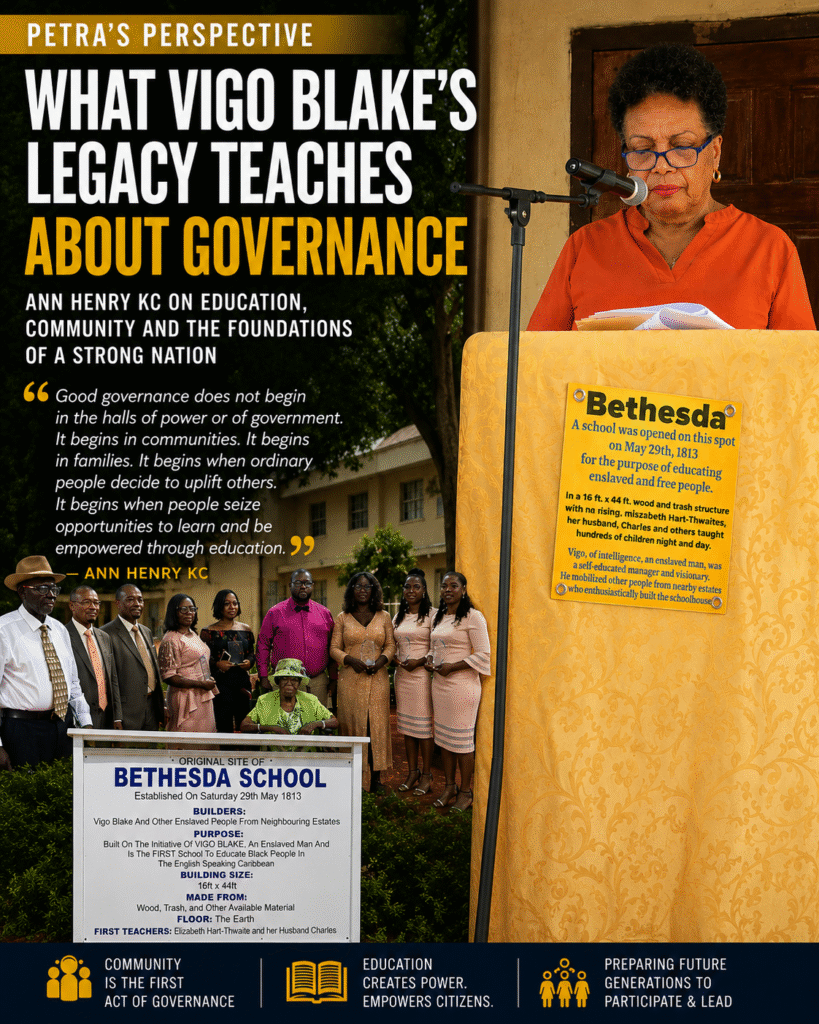
This year’s featured address by E. Ann Henry KC made a powerful contribution to that meditation. Her argument was both simple and profound: that the foundations of good governance are not laid first in Parliament, but in communities, classrooms, and the quiet, determined acts through which ordinary people enlarge the lives of others.
For many, governance is still understood as little more than government. We think of Parliament, ministries, legislation, elections, and the machinery of the state. We associate governance with office, authority, and the visible exercise of power.
Henry invited her audience to think more deeply. She offered a definition of governance that placed people and community at its centre: “Governance speaks of the way in which a community organizes itself for the betterment of the people in that community, how people are empowered, how opportunities are created, and how the community prepares future generations to participate fully in national life and to strengthen, make sustainable and resilient the community for the long term.“
Seen in that light, the story of Vigo Blake is no longer simply the story of a school built in 1813. It becomes a story about empowerment, collective action, and the patient, often unheralded work of nation-building.
Vigo Blake: More Than a Schoolroom Builder
The historical record tells us that Vigo Blake, an enslaved man, promised the Thwaites sisters that if permission were granted to establish a school for enslaved people, he would organise his fellow enslaved workers to build it.
Permission was granted, and the work began.
For six weeks, men, women, and children laboured before dawn and again after long days in the fields to construct what became, according to official records, the first formal schoolroom established for the education of enslaved people in Antigua and across the British West Indies.
The achievement was extraordinary, not only for what was built, but for what it represented: the insistence that even within a system designed to deny humanity, people could still labour towards dignity, knowledge, and a future larger than the one prescribed for them.
Henry urged her audience to look beyond the physical structure itself. “When viewed through that lens, Vigo Blake was not simply a historical figure who built a school. He was a nation-builder; an early advocate for empowerment, who helped lay the foundation for the education of his people, a foundation on which I, and all of us, now stand.”
The phrase nation-builder carries considerable weight. History often reserves such language for political leaders, legislators, and heads of government. Yet Henry’s argument reminds us that some of the most consequential builders of nations never held public office. They built institutions, opened pathways, and helped shape the moral and intellectual life of a people.
That is what Vigo Blake helped to do, and that is why his legacy continues to matter.
Education as an Act of Liberation
At the heart of Henry’s address was a profound meditation on the purpose of education.
She argued that Vigo Blake understood something revolutionary for his own time and enduringly relevant for ours: “He understood that literacy and education were more than learning to read words on a page. He knew that education was dignity and self-worth and preparation for leadership and national engagement.”
That insight lifts education beyond examination results, qualifications, and employment prospects. It restores education to its deeper meaning: preparation for citizenship, participation, judgment, and leadership. In that sense, education is not merely a social good. It is a civic necessity, and, at its best, an act of liberation.
Creating Future Citizens
One of the most striking passages in the address examined the world in which Vigo Blake lived and worked. “At a time when the political and economic systems were designed to exclude and promote ignorance, he helped create inclusion and to promote enlightenment.” She continued: “At a time when his people were denied a voice, he invested in the future voices of a nation.”
Those future voices mattered because the school was doing more than teaching literacy. It was helping to form people who could one day understand, enter, and influence the life of their communities. Viewed in that way, the Bethesda School was never merely an educational institution. It was part of the early architecture of governance itself, because it helped prepare the citizens on whom any just society must ultimately depend.
A Message for Today
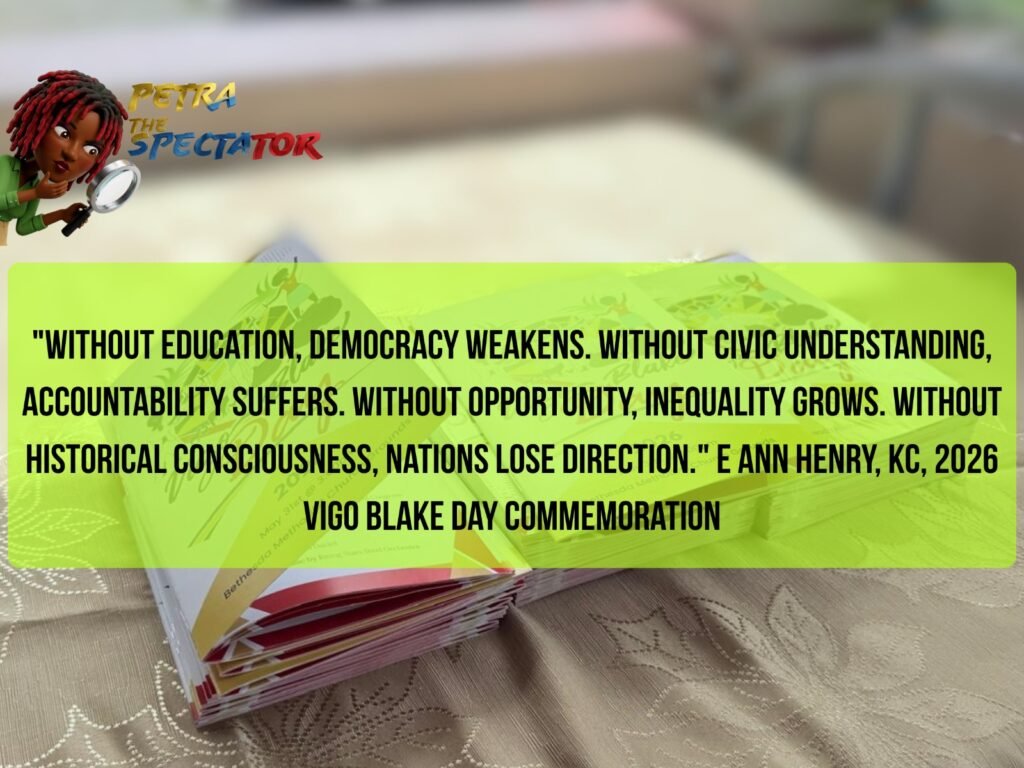
The connection between education and governance became even clearer when Henry turned to the present day. Her warning was unmistakable: “Yet all of those ideals depend on one fundamental requirement: an informed and empowered people. Without education, democracy weakens. Without civic understanding, accountability suffers. Without opportunity, inequality grows. Without historical consciousness, nations lose direction.”
This was not merely a reflection of the nineteenth century. It was a challenge to the twenty-first. The meaning is difficult to escape: strong democracies require informed people, strong communities require engaged people, and strong nations require citizens who are equipped not only to endure history, but to help shape it.
Governance Begins at Home
Perhaps the most memorable passage of our esteemed E Ann Henry, KC’s speech came near its conclusion. “Good governance does not begin in the halls of power or of government. It begins in communities. It begins in families. It begins when ordinary people decide to uplift others. It begins when people seize opportunities to learn and be empowered through education.”
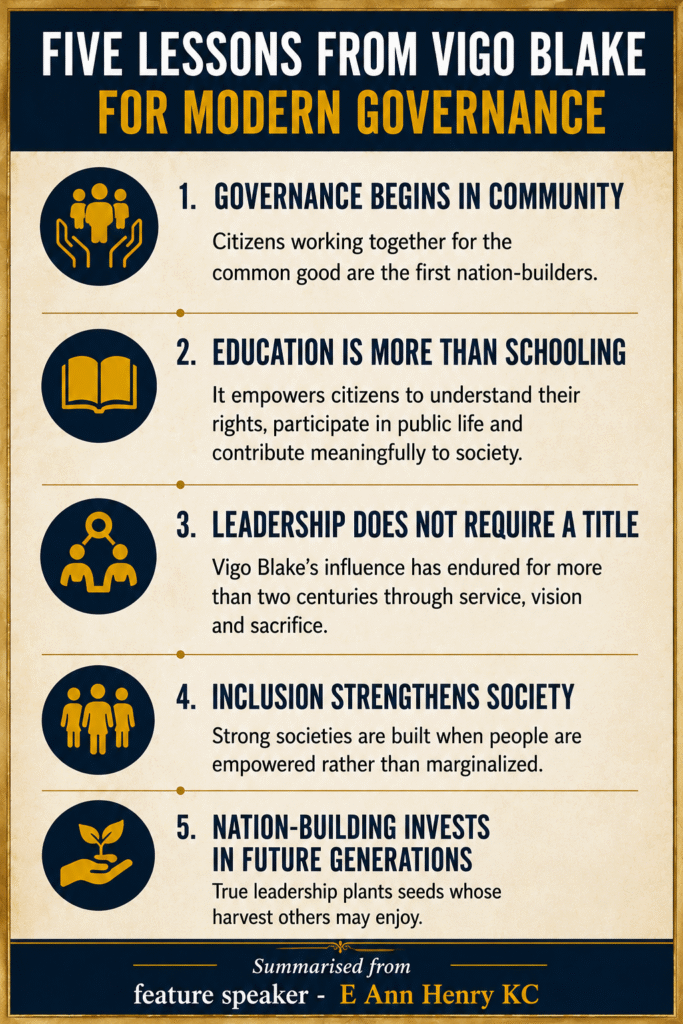
There may be no finer summary of what Vigo Blake’s life continues to teach us. Long before constitutions and public institutions, there was community. Long before policy frameworks, there was empowerment. Long before development plans, there was education.
More than two centuries later, those foundations remain essential. Vigo Blake’s true significance lies not only in helping to build a classroom, but in understanding what classrooms can build: a people conscious of their dignity, alive to their responsibilities, and capable of shaping a nation worthy of them.