

When tea leaves stop swirling, they settle. And sometimes, what they reveal is not a surprise, but confirmation.
What do the tea leaves say when one man, it seems, did change the world? Or more precisely, when his departure exposes just how fragile the political ecosystem around him had already become.
The state of the United Progressive Party’s St George constituency may now be the clearest public signal that the party remains unsettled, still haemorrhaging internally, and far from being in fighting shape for the next general election. What is unfolding there is not an isolated constituency problem. It is a visible symptom of deeper, unresolved fractures, the fallout from a bruising leadership race, compounded by the impatience and disappointment that followed the party’s narrow loss in the last general election.
St George, once a meaningful battleground, now flirts openly with irrelevance.

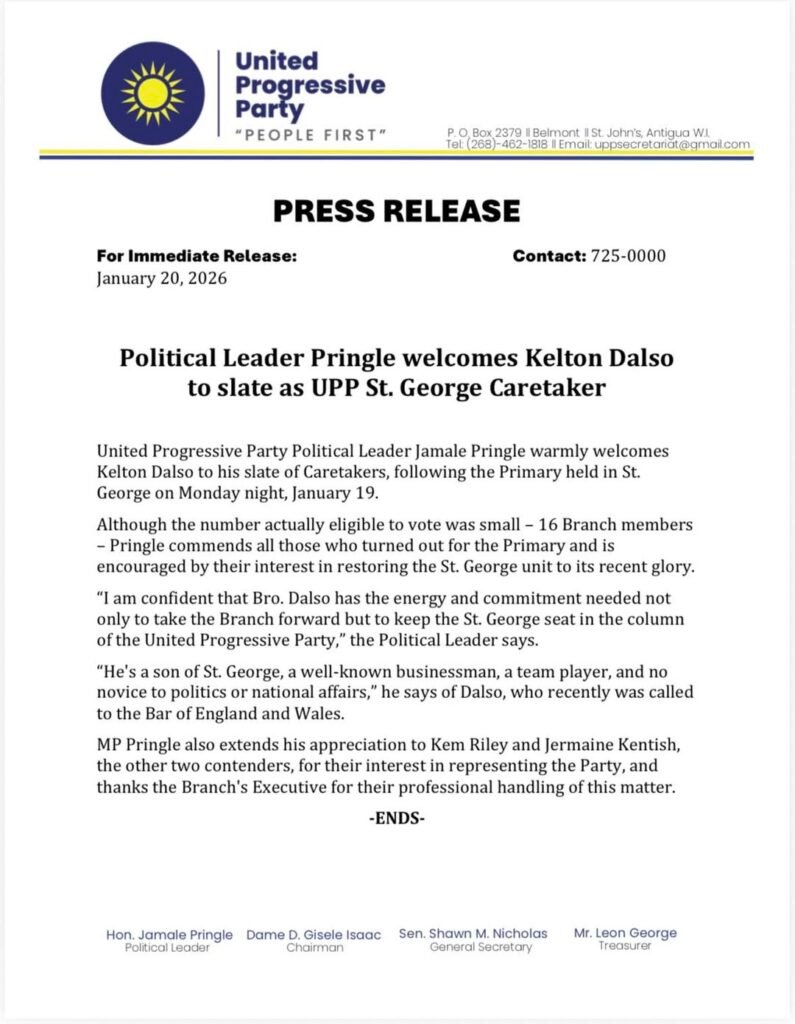
The numbers alone tell a sobering story. At the recently held primary, less than 10 percent of the branch’s 220 members were in good standing to participate in the elections. Simply put, none of the prospects were able to galvanise support from the engine room of the UPP’s St George Branch.
This was not due to a lack of visibility. Senior party figures were present in the constituency, yet their involvement failed to generate turnout or momentum, highlighting a deeper breakdown in branch cohesion.
A branch that cannot mobilise its own membership cannot credibly mobilise an electorate. The paltry turnout suggests a structure operating on fumes.
That reality stands in sharp contrast to where the constituency stood only a few years ago. In July 2020, Algernon Watts defeated Jermaine Kentish by 74 votes to 22 to become the UPP’s candidate for the St George constituency. That start was galvanised into a thriving, active branch, engaged and energised.
Its subsequent decline, under the strain of internal wrangling and other compounding factors, underscores just how far the UPP in St George has fallen.
One cannot reasonably expect to retain a parliamentary seat without doing the unglamorous, continuous work of maintaining a living, breathing branch. Organisation is not optional in politics; it is the critical success factor.
Compounding the organisational decay is the lack of clarity surrounding the Member of Parliament’s departure. Grey areas suggest that among the reasons cited is an unwillingness to be governed by the existing political leadership. Whether one accepts that framing or not, its prevalence points to a deeper truth: questions of authority, alignment, and cohesion remain unresolved within the party.
The subsequent rounds of candidate selection for the various branches did little to repair that damage. Rather than being accompanied by robust, energising branch elections, the process leaned heavily toward quiet selections and hand-picked outcomes. Opportunities to fire up the base, rebuild trust, and expand membership were largely missed. In politics, silence is rarely neutral. More often, it signals disengagement.
The broader context only sharpens the picture. The loss of key members of campaign teams, the All Saints West defection, or perhaps more accurately, the drift toward the centre, and persistent infighting. Open hostility toward sitting candidates. And increasingly disjointed opposition tactics that often appear in conflict with the very idea of national development.
Taken together, these are not the signs of a party sharpening its tools for governance. They are the signs of a party still arguing about the toolbox.
Political organisations rarely collapse all at once. They erode: branch by branch, volunteer by volunteer, seat by seat. Constituencies like St George do not suddenly become irrelevant, they are neglected into it.
The tea leaves here are not ambiguous. They point to a party still wrestling with itself at a moment when the electorate is watching closely, and patience is thin. The next election will not wait for internal healing. History, after all, is unforgiving to organisations that mistake internal conflict for strategy.
If St George is the mirror, the reflection may be uncomfortable. But it is also instructive. The only remaining question is whether anyone is prepared to look long enough to act on what they see.