
Visa Lines, Loud Stands, and the Geography of Reality
The thing about local football matches is that you come for the game but leave with sociology.
There I was, minding my business, half-watching a midfield battle, when two men behind me launched into a full-volume discussion on the state of the world; not tactics, not referees, but Visas.
It started heavy. Real heavy. They spoke of travel restrictions tightening like a vise grip . Of loved ones unable to access overseas medical care. Of missed opportunities, delayed diagnoses, and the quiet humiliation of paperwork that never seems to move fast enough when your health depends on it. It was raw. Emotional. The kind of conversation you don’t interrupt, even accidentally, because it is carrying somebody’s lived truth.
Heads nodded nearby. A few people murmured agreement. In small places, these stories are never unique.
Then, without warning, the conversation shifted gears. One man, voice suddenly lighter, began outlining future vacation plans. Destinations were named confidently. Dates imagined optimistically. Sun, shopping, relaxation, the works.
That’s when the other man paused and asked, genuinely puzzled, where exactly the passport office is located these days. Not a trick question or being sarcastic.
He had no idea. Never applied. Never needed to. Never been. This plot twist landed quietly, like a bad referee call that takes a second to register.
Moments later came the closer. The other man admitted his biggest overseas trip to date was to Montserrat.
And just like that, the entire visa debate rearranged itself.
This is the Caribbean paradox in a nutshell. We speak fluently about global mobility, sanctions, border tightening, and international inequities, often with deep personal pain attached. Yet for many, the machinery of travel itself remains abstract. Offices never visited. Forms never filled. Processes never learned until crisis arrives.
It is not ignorance but rather access layered with habit and history.
For generations, movement was limited not just by visas but by money, confidence, and the quiet belief that certain doors were simply not for you. So, when restrictions tighten now, they don’t just close borders. They expose gaps! Knowledge gaps! Experience gaps! Psychological gaps!
The humour is unintentional because Caribbean people always find humour. A man passionately critiquing visa policy who has never stood in a passport line. Another is dreaming of far-off vacations while his travel history fits neatly inside a fifteen-minute plane ride.
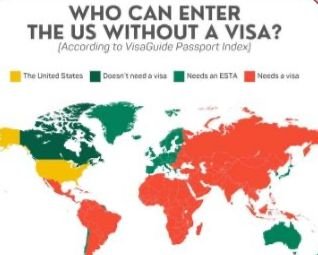
But beneath the chuckle sits something serious. Mobility is no longer optional. It intersects with health care, education, family survival, and dignity. And yet, we are still not preparing people early enough for that reality. Not practically. Not culturally.
So yes, visa restrictions are tightening. That part is true. But so too is this. For many, the real barrier begins long before the embassy. It starts with not knowing where the passport office is, or believing that Montserrat is as far as life ever intended you to go.
Football ended two-nil that day. Fair result.
The conversation, though, was a draw between laughter and discomfort. Which is often where the most honest truths live.
Two Pageants, One Region, and the Weight of a Crown
If you ever wanted proof that Caribbean culture does not travel in straight lines, look no further than this week’s pageant conversations. On one end of the region, rules were sharpened with surgical clarity. On the other, a crown was contested by exactly two women. Somewhere between Anguilla and St. Croix, the Caribbean quietly reminded us that culture survives through both structure and stubbornness.
In Anguilla, the Miss Anguilla Pageant made headlines not with a sash but with a sentence. Registration notices for the 2026 competition explicitly stated that contestants must be “born female,” along with long-standing requirements for age, residency, education, language fluency, and marital status. The organizers’ message was clear. This pageant stands firmly within traditional definitions and wants no confusion before heels even hit the stage.
Predictably, the region responded with commentary. Some applauded the clarity. Others questioned the timing and implications in a world where pageants elsewhere are rethinking inclusion. And many simply noted that in small societies, pageants are never just pageants. They are cultural signposts, loaded with meaning far beyond the crown itself.
Then, almost on cue, St. Croix entered the chat.
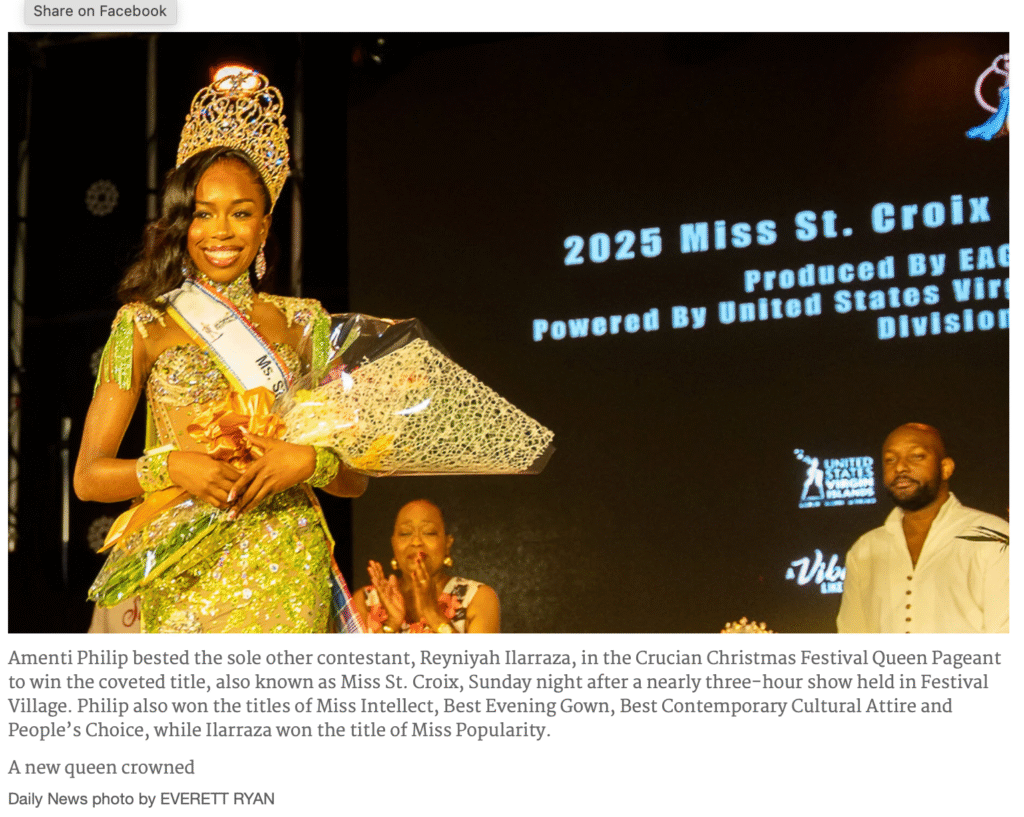
At the Miss St. Croix Festival Queen Pageant, part of the Crucian Christmas Festival, there were just two contestants. Two! On seeing the results and probing further, somewhere between a chuckle and a think-piece, I affectionately dubbed the duo Ms First and Ms Last.
The production unfolded in full. Stage. Judges. Lighting. Gowns. Rehearsals. Trophies. The same fixed costs, the same cultural seriousness, the same sense of occasion that has defined the pageant for over seven decades.
When the tiara was placed, Miss St. Croix Festival Queen, sweeping major segments including Best Evening Wear, Best Contemporary Cultural Attire, and Miss Intellect. The first runner-up claimed Miss Popularity. Between them, they carried the entire competitive load, gracefully and without irony.
Taken together, Anguilla and St. Croix tell a single Caribbean story from two angles.
Anguilla shows us boundaries. The instinct to define, preserve, and protect tradition in a time of global flux. St. Croix shows us persistence. The determination to stage culture even when numbers dip, applause is thinner, and participation no longer guarantees spectacle.
Both are acts of cultural self-definition.
Beneath the humour lies something serious. Youth engagement is shifting. Migration, economics, and evolving social norms are reshaping who steps forward and why. Yet pageants remain, sometimes rigid, sometimes resilient, because they serve as mirrors. They reflect how societies see womanhood, leadership, and national pride at a given moment.
So yes, one island clarified who may enter. Another crowned a queen from a field of two. And the Caribbean, as always, found room for laughter, debate, and reflection all at once.
Because here, culture does not wait for perfect conditions. It adapts. It insists. And whether contested by dozens or defended by definition, the crown still carries weight.
When Geopolitics Meets Streetwear Culture
In one of this year’s most surreal cultural crossovers, a photo of Nicolás Maduro has transformed a routine piece of athletic wear into a must-have “it item” for 2026, and not because of any traditional fashion campaign. The image was shared by Donald Trump on his Truth Social account following Maduro’s capture by U.S. forces earlier this month, showing him aboard the USS Iwo Jima wearing a grey Nike Tech Fleece tracksuit.
The result? A perfect storm of geopolitics, internet culture, and consumer desire.

Within hours of the photo circulating, online interest in the Nike Tech line, a minimalist, mid-weight athleisure fleece, spiked dramatically. Searches for the tracksuit surged on Google and X, and social media feeds lit up with memes, “steal the look” posts, and tongue-in-cheek reviews breaking down how to replicate Maduro’s unintentional aesthetic.
Some sizes of the iconic grey hoodie and joggers reportedly sold out across Nike’s U.S. online store, while broader global demand peaked in parts of Europe and North America as fashion enthusiasts, meme lovers, and the merely curious clicked “Add to Basket.”
Online reactions ranged from tongue-in-cheek praise, dubbing the silhouette “Maduro grey”, to quick-chat memes remixing the photo into pop culture hits and Halloween inspiration. The trend encapsulates how visual shorthand now shapes global discourse: a single snapshot can make complex geopolitics feel oddly familiar when framed through something as relatable as a tracksuit.
Many users pointed out the intense irony. Here is a long-time critic of Western influence and capitalism, suddenly boosting the profile and bottom line of an American sportswear brand without Nike lifting a marketing finger. For some, it is “guerrilla branding at its finest”; for others, it’s a reminder that in the digital age, everything is fodder for culture and commerce.
This unexpected fashion moment lays bare a few modern truths. First, visuals travel faster than analysis; people engage with the image first, then the narrative follows. Second, consumer and cultural conversations blur quickly; a military or political drama can morph into a product trend within hours. And finally, humour and relatability reign; even in serious geopolitical crises, the internet finds a way to make the moment feel accessible and shareable.
In a world where political theatre and social media spectacle are increasingly entangled, this viral spike shows how branding exposure can come from the most unlikely of places: not from planned campaigns, but from unexpected snapshots that capture both global tension and our collective attention. Fashion week this is not. But for 2026? It might just be the most talked-about athleisure moment yet.
Entertainment, Caribbean Style