
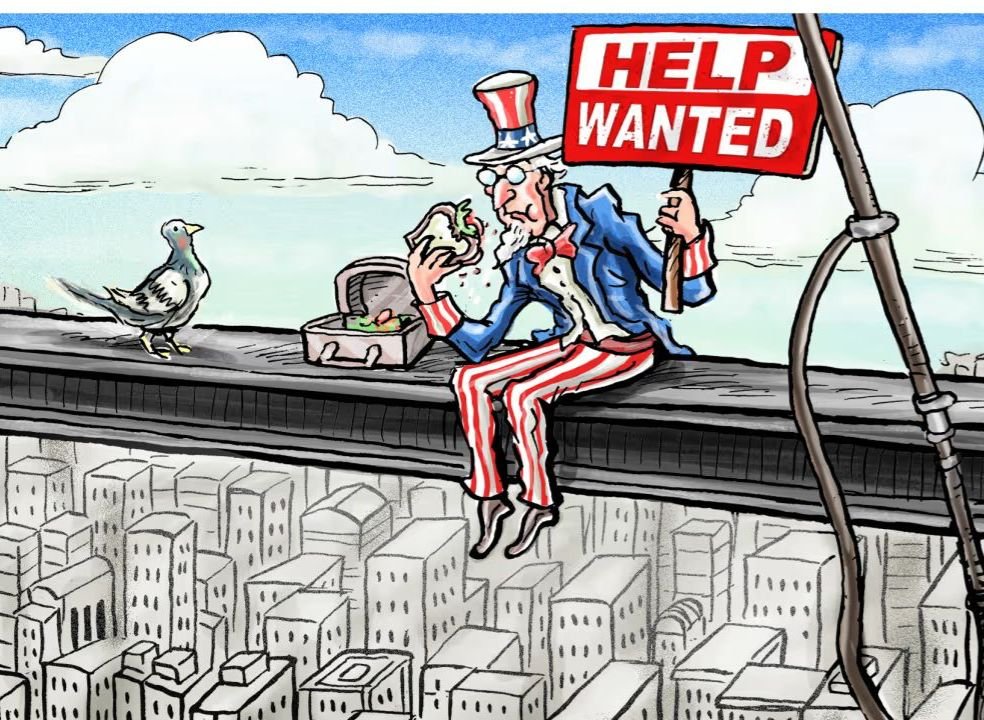
For much of the past decade, the United States has functioned as the global economy’s stabiliser of last resort. Even when growth slowed elsewhere, America continued to generate jobs, sustain consumer confidence, and absorb imports of goods, tourists, and services from partner economies. Its labour market acted as a shock absorber, transmitting demand outward through trade, travel, and investment.
In 2025, however, that engine is no longer roaring. It is still running, but at a noticeably lower gear, and the implications extend well beyond U.S. borders.
A Labour Market Still Growing — But Losing Momentum
On paper, the American labour market remains intact. Jobs are still being added, but the pace has slowed markedly. In the first nine months of 2025, average job creation hovered around 76,000 jobs per month, less than half the 2024 average. Some months came perilously close to stalling altogether. August, for example, produced barely 22,000 net new jobs.
At the same time, unemployment edged up to 4.4 per cent, the highest level in nearly four years. Job openings fell to about 7.7 million, down sharply from the post-pandemic peak of 12 million. The quit rate declined to 1.8 per cent, its lowest since mid-2020, signalling that workers are holding on to jobs more tightly because better opportunities no longer feel abundant.
These trends are summarised in the labour market indicators below, which together show an apparent loss of momentum even as headline employment remains positive.
Table 1 – Key U.S. Labour Market Indicators (2024–2025)
| Indicator | 2024 | 2025 (Latest) | What It Signals |
| Average monthly job creation | 168,000 jobs | 76,000 jobs | Hiring momentum slowed |
| Lowest monthly job gain | 90,000 | 22,000 (Aug) | Near-stall hiring |
| Unemployment rate | 3.7% | 4.4% | Highest in ~4 years |
| Job openings (JOLTS) | 9.6m | 7.7m | Weaker demand |
| Layoffs & discharges | 1.6m | 1.8–1.9m | Rising layoffs |
| Quit rate | 2.3% | 1.8% | Lower confidence |
Source: US Bureau of Labour Statistics
These indicators point to a labour market that is cooling, not collapsing, but doing so in a way that meaningfully alters behaviour and expectations.
Structural Cooling: Government Cuts and Corporate Retrenchment

This slowdown reflects deliberate structural change as much as cyclical weakness. Under the DOGE-era drive for government efficiency, federal employment declined, directly weighing on headline job growth. There has been no meaningful rehiring of displaced federal workers into public-sector roles. Instead, many have been pushed into a private sector that is itself becoming more cautious.
Corporate America is retrenching as well. Two heavy hitters illustrate the breadth of the shift. Amazon’s decision to cut roughly 14,000 corporate jobs and Verizon’s reduction of more than 13,000 positions are emblematic of a broader recalibration across technology, telecommunications, logistics, and professional services. Firms are reorganising around automation, artificial intelligence, and leaner operating models, prioritising efficiency over expansion. Even when revenues remain healthy, payrolls are being trimmed, reshaping sentiment faster than any official data release.
Table 2 – Major Corporate Layoffs (2025)
| Company | Jobs Cut | Sector | Strategic Context |
| Amazon | ~14,000 | Tech / Logistics | AI-led restructuring |
| Verizon | 13,000+ | Telecoms | Retail & network consolidation |
Source: https://www.sfchronicle.com/california/article/unemployment-tech-layoffs
These layoffs do not define the entire U.S. labour market, but their scale and visibility amplify uncertainty and reinforce a broader narrative of caution.
Tariffs, Reshoring, and the Manufacturing Reality
President Trump’s tariff policies were intended to revive domestic manufacturing and encourage reshoring. From an employment perspective, the results have been underwhelming. Manufacturing job growth has remained weak, and in some periods, outright negative, as higher input costs, retaliatory pressures, and automation blunt the labour impact of returning production.
Even when factories come back to U.S. soil, they increasingly do so without workers. Capital replaces labour, and productivity gains fail to translate into broad-based employment or wage growth. The anticipated manufacturing jobs renaissance has not materialised, leaving a gap between policy intent and labour-market outcomes.
Job Quantity Versus Job Quality
Health care and hospitality continue to prop up overall job numbers, but this support masks important weaknesses beneath the surface. These sectors are expanding largely because of structural necessity rather than economic exuberance: ageing populations, post-pandemic care backlogs, and sustained demand for in-person services. While they generate employment, many of these jobs are concentrated at lower or mid-wage levels, offer limited productivity gains, and lack the strong multiplier effects associated with manufacturing, technology, or high-value professional services.
As a result, even as headline employment remains positive, the composition of job growth is less likely to drive robust wage increases, household wealth accumulation, or broad-based consumer confidence. The labour market may still be growing, but it is doing so in ways that are less likely to sustain strong consumption or support the kind of discretionary spending that fuels travel, imports, and external demand.

This imbalance helps explain why consumer sentiment has softened even in the absence of a dramatic collapse in employment. When job growth is concentrated in sectors with limited wage progression and weaker spillover effects, households may be employed, but they do not necessarily feel secure or prosperous.
The Confidence Channel: Why Spending Is Softening
The result is cautious behaviour: restrained spending, delayed purchases, and heightened sensitivity to price and value. As job mobility declines and wage growth cools, this caution becomes entrenched, shaping economic behaviour well beyond the labour market itself. In effect, the U.S. economy is generating work without generating the confidence that traditionally accompanies strong employment cycles.
With consumer spending accounting for roughly 70 per cent of U.S. economic activity, even modest shifts in confidence can have outsized effects. Households facing greater uncertainty are more likely to postpone big-ticket purchases, reduce discretionary outlays, and prioritise savings over consumption. High-profile layoffs at household-name firms reinforce these instincts, amplifying caution even among those whose jobs remain secure. Over time, softer consumer demand feeds back into corporate decision-making, discouraging hiring, restraining wage growth, and reinforcing a slower, more defensive economic cycle.
This distinction between employment quantity and employment quality is crucial because it shapes not just whether Americans are working but also how confidently they spend.
When America’s Caution Travels Abroad
Once consumer behaviour shifts in the United States, the effects rarely stop at domestic borders. An economy driven as heavily by consumption as America’s inevitably exports its confidence — or its caution — through trade, travel, investment, and services. For regions closely tied to U.S. demand, particularly the Caribbean, these behavioural shifts act as early warning signals, often appearing in booking patterns, contract negotiations, and remittance flows well before they surface in headline statistics.
Why The Caribbean Should Pay Attention
For the Caribbean, these shifts matter immediately. The United States remains the region’s largest tourism source market, and discretionary travel is usually among the first behaviours to tighten when American households feel uncertain. A prolonged period of slower job growth could translate into softer winter bookings, shorter stays, reduced in-country spending, and heightened price sensitivity across destinations.
Table 3 – Caribbean Implications of U.S. Job Shifts
| Area of Impact | Implications for the Caribbean |
| Tourism Demand Becomes More Price-Sensitive | Slower U.S. job growth and rising layoffs make American travellers more cautious, leading to shorter trips, fewer upgrades, reduced on-island spending, and greater comparison shopping between destinations. |
| Export Demand Tightens Beyond Tourism | Weak U.S. manufacturing growth and corporate cost-cutting reduce demand for Caribbean exports such as rum, specialty foods, chemicals, packaging, and light manufactured inputs. |
| Pressure on Service Exports & Outsourcing | DOGE-era federal job cuts and private-sector restructuring increase scrutiny of contracts, creating tougher conditions for outsourcing, logistics, education, consulting, and digital services. |
| Diaspora Flows Lose Momentum | Job insecurity among middle-income U.S. households can flatten remittances and shift diaspora spending from investment toward maintenance. |
| Reshoring Without Jobs Brings Limited Spillover | Automation means returning production creates few jobs, limiting wage growth and U.S. consumption spillovers. |
Beyond tourism, U.S. consumer caution can negatively affect demand for Caribbean goods and services, from niche exports to business-process outsourcing. Demand for rum, specialty foods, chemicals, packaging materials, and light-manufactured inputs becomes more price-sensitive. Procurement tightens, inventories are managed aggressively, and smaller suppliers feel pressure first. Service exports face similar headwinds, with greater scrutiny on outsourcing, logistics support, consulting, education, and digital services.
Diaspora-linked flows add another vulnerability. Middle-income U.S. households underpin remittances, property investment, and other aspects of Caribbean economies. When job security weakens, remittances tend to flatten and diaspora spending shifts from expansion to maintenance.
A Signal, Not Yet A Downturn
America’s job engine has not stalled entirely, but it is no longer the dependable growth machine the Caribbean has long relied upon. The cooling of the U.S. labour market is not only a domestic story; it is a signal that Caribbean economies must watch closely, because shifts in U.S. job confidence often arrive at our shores long before they are reflected in official data.
Diversification, competitiveness, and value creation must therefore take centre stage. As the U.S. economy recalibrates toward caution and efficiency, Caribbean resilience will need to go from passive dependence to deliberate strategy. In the next phase of global adjustment, resilience, not reliance, will determine who weathers the change.