
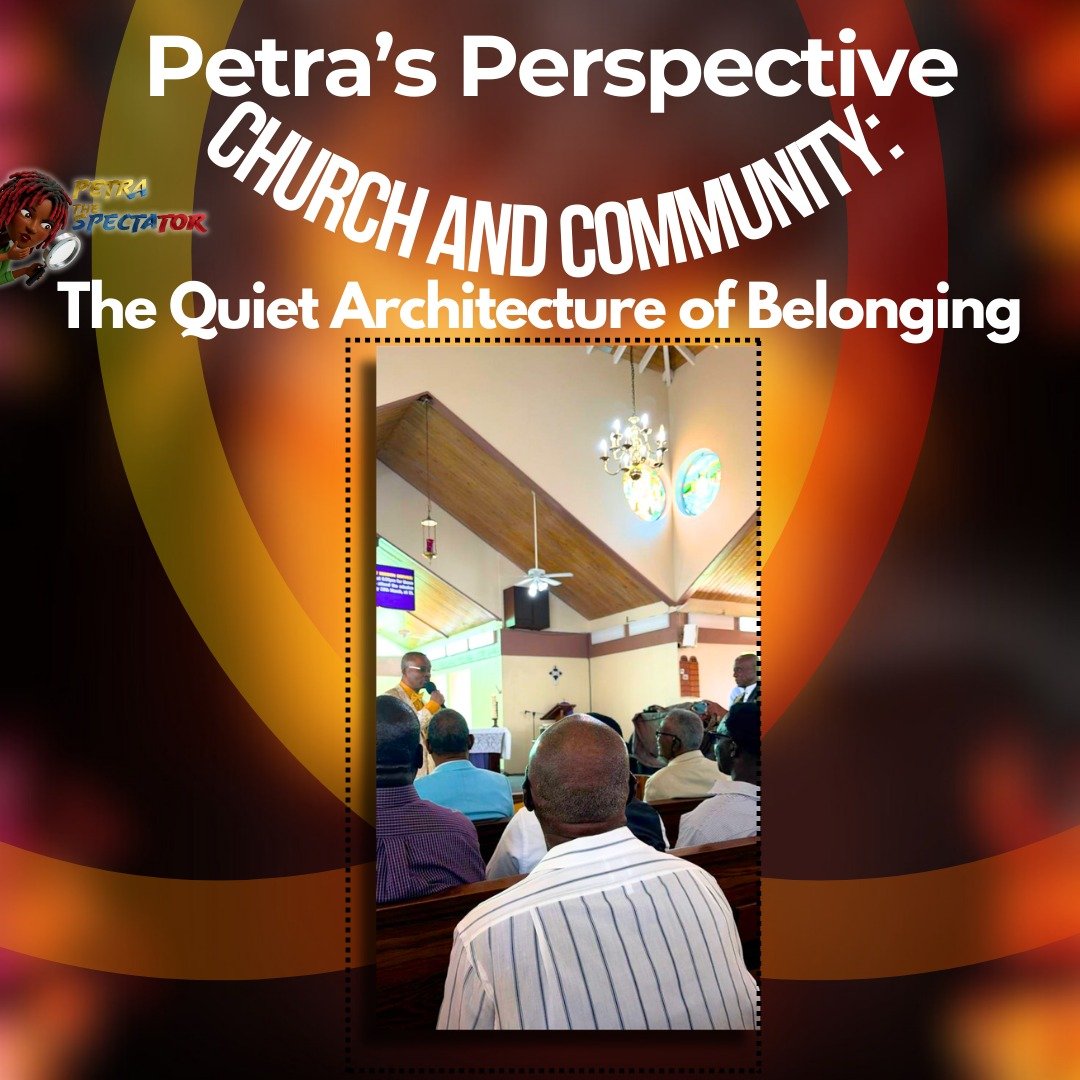
There are moments when a story does not arrive loudly. It does not announce itself with spectacle or urgency. Instead, it settles quietly, like a familiar hymn or a verse of scripture you didn’t realise you still remembered.
Glenmore “King Progress” Sheppard’s 65th birthday service at the All Saints Anglican Church was one of those moments.
It was not, by his own design, the usual birthday bash. Not an ‘Oldie Goldie Party’ of Antiguan soul food (never had a traditional Barbuda dish there), hours on the dance floor of the living room. No gathering spilling out into laughter on the front or side decks, in the back yard, or in the kitchen. Instead, he extended a simple invitation: come to church.
And in doing so, he offered more than a celebration. He offered a return.
“We Turned Our Backs on the Church”
Speaking upon invitation during the notices, Sheppard shared a moment that lingered long after the service ended:
“In August, last year, I had a sibling reunion…, and as part of the week of activities, we decided to come to church and then have lunch. When I came to church, I realised that church was half empty… and I said to myself, you know what? Me included, we turned our backs on the church. And the church would have played a major role in our upbringing. So, I decided… let’s go back to church.”
That reflection did not land as criticism. It landed as recognition.
Because for many of us, church was never just about Sunday worship. It was infrastructure. Not of buildings, but of becoming.
Growing Up Church-Built
For most of us raised in Antigua and Barbuda, church life was not a compartment. It was an ecosystem.
Sunday School shaped early ideas of right and wrong. Youth groups doubled as social circles, quietly teaching leadership, time management, and responsibility. Choir rehearsals and programme preparations demanded discipline, harmony, and order.
Youth organisations, often structured with near para-military precision, taught cooperation, respect, and engagement, while also forming the foundation of social connections that would later evolve into families.
Easter fairs, bazaars, and concerts blurred the line between faith and festivity, offering safe spaces for teenage exploration and community interaction.
I could go on, but you get the drift.
In essence, the church was where the community learned to gather, organise, and care. For many, though not all, it functioned as a safe space where we learned to care for each other.
Before we spoke about community development in policy terms, we lived it. In church halls, on wooden pews, and under zinc roofs that echoed with sermons, bible verse and song.
The Slow Drift and the Quiet Return
But somewhere along the way, many of us drifted. Some abruptly, others rebelliously. For others, gradually.
Schedules grew fuller; priorities shifted, and the rhythm of Sunday softened into optional.
But, in King Progress 65th birthday gesture, there was recognition that the distance was not so far. He called, and we came.
Building on the movement from August 2025 to his ‘own homeland’, for regular Sunday worship, the numbers swelled close to 50 last Sunday as he pulled across his circles: long-standing friends, the calypso fraternity, his party people.
Scores answered the call of a sibling, kin, a friend, a colleague, a fraternal brother.
Church as Social Capital
There is a language economists use: social capital. It speaks to networks, trust, and shared values. The invisible threads that hold societies together.
Church, in its most active form, has long been one of the Caribbean’s most effective builders of that capital. It connects generations, reinforces shared identity, provides informal support systems in times of need, and creates spaces for leadership, mentorship, and service.
Long before formal institutions scaled up, the church was already doing the quiet work of nation building.
In marking his milestone, King Progress used a personal moment to rebuild a communal habit. A birthday became a bridge between past and present, easing the distance between absence and return.
Sitting there, listening, I could not help but reflect on just how much of my own foundation was shaped in those same spaces: the structure, the discipline, the sense of belonging.
Even the ability to stand, to speak, to organise, to tell stories, all of it traces back, in some way, to the church.
We may step away from church as a place, but the imprint of church as a formation rarely leaves us.
The Invitation Beyond One Man
Glenmore Sheppard extended an invitation to his circle. And for many of us, it is a path that we walk for special occasions.
His actions reflect a broader commitment to participate consistently and include others. What would it mean for us to return, not just physically, but as a community? Not necessarily to recreate what was, but to re-engage what worked.
Because if community development is about people, connection, and shared purpose, then one of the oldest institutions we know still has a role to play. Perhaps more of us need to reclaim, like that hymn or scripture verse you suddenly remember, word for word.
As Glenmore continues to give thanks for life at 65, his celebration offers more than just a personal milestone. It presents an opportunity to reflect on the institutions that raised us and to reconsider their role today. Even in changing seasons, their enduring value in shaping the community remains.