
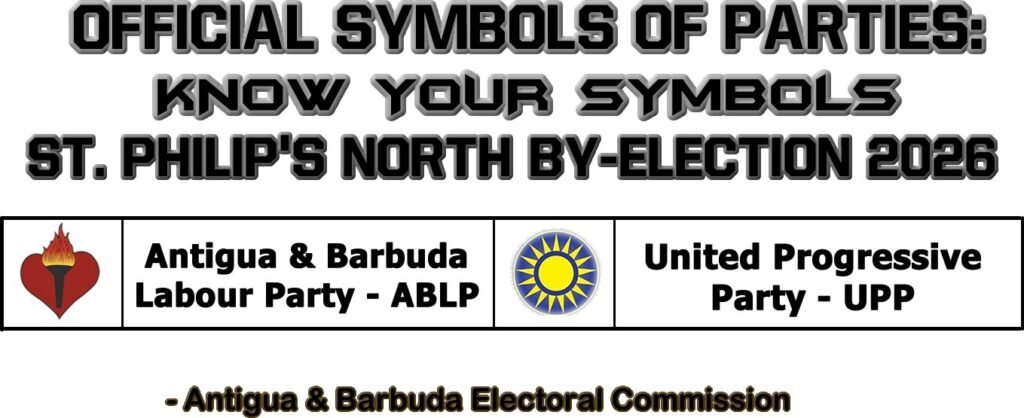
The by-election in St. Philip’s North might seem like a routine democratic process at first glance. It was caused by the resignation of Sir Robin Yearwood, ending one of the longest continuous parliamentary careers in the Commonwealth. For fifty years, a single political figure represented the constituency, with a political style that was deeply personal and rooted in the community.
Yet beneath the surface, the vote carries several layers of political meaning for both government and opposition.
The Parliamentary Arithmetic
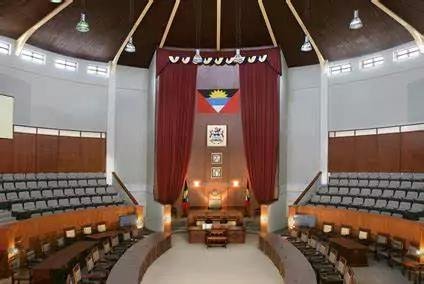
The Antigua and Barbuda Labour Party (ABLP) emerged from the 2023 general election with a razor-thin parliamentary majority, securing nine of the seventeen seats in the House of Representatives.
In the months that followed, the parliamentary landscape shifted in ways that strengthened the government’s position. Anthony Smith, Member of Parliament for All Saints West, elected on the United Progressive Party (UPP) ticket, moved to sit as an independent in July 2024 while aligning himself with the government’s legislative and executive agenda.
Then, in January 2025, the governing party regained St. Peter’s when Rawdon Turner won the by-election that followed the death of the constituency’s independent Member of Parliament and former ABLP member, Asot Michael.
Those developments gradually transformed what began as a fragile majority into a far more comfortable parliamentary position for the government.
A victory in St. Philip’s North would largely maintain that stability. A loss would not threaten the government’s control of Parliament, but politically it would be interpreted as a breach in what has long been regarded as a dependable Labour constituency.
The Deputy Speaker Question
There is also a quieter institutional matter related to the vote. During his last term, Sir Robin Yearwood served as Deputy Speaker of the House of Representatives. If the Labour Party’s candidate, Randy Baltimore, wins the seat, observers expect that he will likely assume that parliamentary role, maintaining the current structure within the House.
If the opposition candidate Alex Browne prevails instead, the government would have to appoint another member from its ranks to serve as Deputy Speaker, potentially requiring a quiet reshuffling of parliamentary responsibilities.
While procedural in nature, such adjustments carry practical implications for how the House organises its leadership.
The Legacy Debate
Beyond parliamentary numbers, the by-election has also revived discussion about the political legacy of Sir Robin Yearwood.
For decades, his representation of St. Philip’s North was defined by direct personal engagement with constituents. Residents frequently cite assistance with securing employment opportunities, access to land for housing, guidance on home construction financing, and encouragement of entrepreneurial ventures. That style of representation fostered a reputation for tangible, individual empowerment.
At the same time, the campaign has reignited a broader discussion about development within the constituency. Critics argue that although some individuals benefited from direct assistance, the area today has few established community institutions, organised youth programs, and coordinated economic efforts.
In that sense, the by-election has quietly transformed into a debate over which model of representation the constituency now favors: continuing a legacy of personal advocacy, moving toward a more organised approach to community development, or a mixed model for maximum benefit.
A Moment for the Opposition
For the United Progressive Party, the contest carries importance beyond St. Philips North. Since narrowly losing the 2023 general election, the party has struggled to regain momentum amid shifting parliamentary alignments, significant high-profile departures, and internal pressures. A win in St. Philip’s North would not change the governing majority, but it could send a strong political message that the party remains competitive and capable of regaining ground.
In political terms, such a result would serve as the kind of balm a party often needs after a bruising electoral cycle, helping to stabilize its base and restore confidence among supporters.
A Constituency at a Crossroads
Ultimately, the by-election in St. Philip’s North represents more than a routine replacement of a long-serving Member of Parliament.
It is a moment of transition for a constituency that, for half a century, was defined by the presence of a single political figure. The vote will determine not only who occupies the parliamentary seat, but also how the next chapter of representation in the constituency will be written.
In parliamentary arithmetic, it is one seat. In political symbolism, it is a referendum on continuity, legacy, and the evolving expectations of representation in Antigua and Barbuda.
hi!,I love your writing so much! proportion we be in contact more
about your article on AOL? I require an expert on this house
to resolve my problem. Maybe that is you! Having a look forward to look you.