

Antigua and Barbuda’s journey at the CARIFTA Athletics Games is not a straight line. It is a long, shifting arc that begins in the field, accelerates on the track, pauses, recalibrates, and rises again.
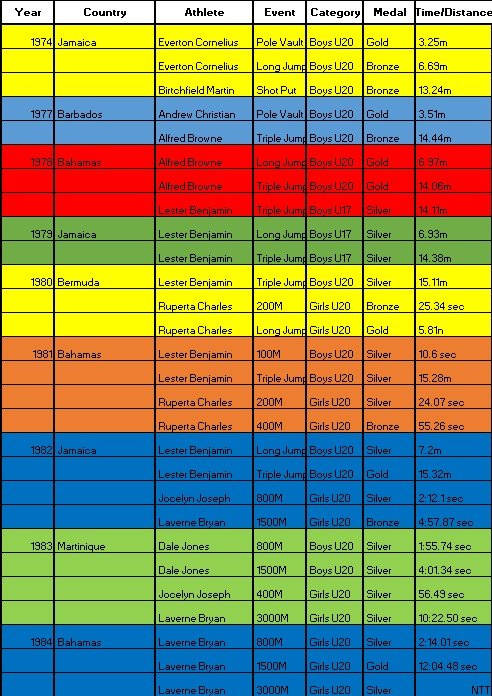
Over the decades, the country has won 116 medals: 41 gold, 34 silver, 41 bronze. A review of Antigua and Barbuda’s CARIFTA medal distribution over time reveals a clear transformation:
- Early years: Dominance in field events
- Transitional period (1990s–early 2000s): Balance between middle-distance and emerging sprint success
- Modern era: Increased medal share from sprint events, supported by continued field contributions
This movement over time reflects changes in coaching emphasis, athlete development pathways, and exposure to international competition.
Antigua and Barbuda’s track and field programme is layered with seeds of possibilities for world-class performances.
The foundation years tell a clear story. When Bertsfield Martin and Everton Cornelius opened Antigua and Barbuda’s CARIFTA account in 1974, they did so in field events. That pattern would define the country’s early identity. Through the late 1970s and 1980s, success leaned heavily toward jumps and throws, supported by disciplined middle-distance performances.
In the 1990s Athletes like Lester Benjamin, Ruperta Charles, and Laverne Bryan did more than win medals; they established a structure. Antigua and Barbuda was not a sprint powerhouse. It was a relatively small, technically grounded programme, finding strength in precision, rhythm, and execution.
The medals came steadily, quietly. Respect was earned.
A Moment Frozen in Controversy
Then came 1989.
Heather Samuel’s race should have been simple; a win decided in a photo finish. She was declared the victor. The gold was hers.
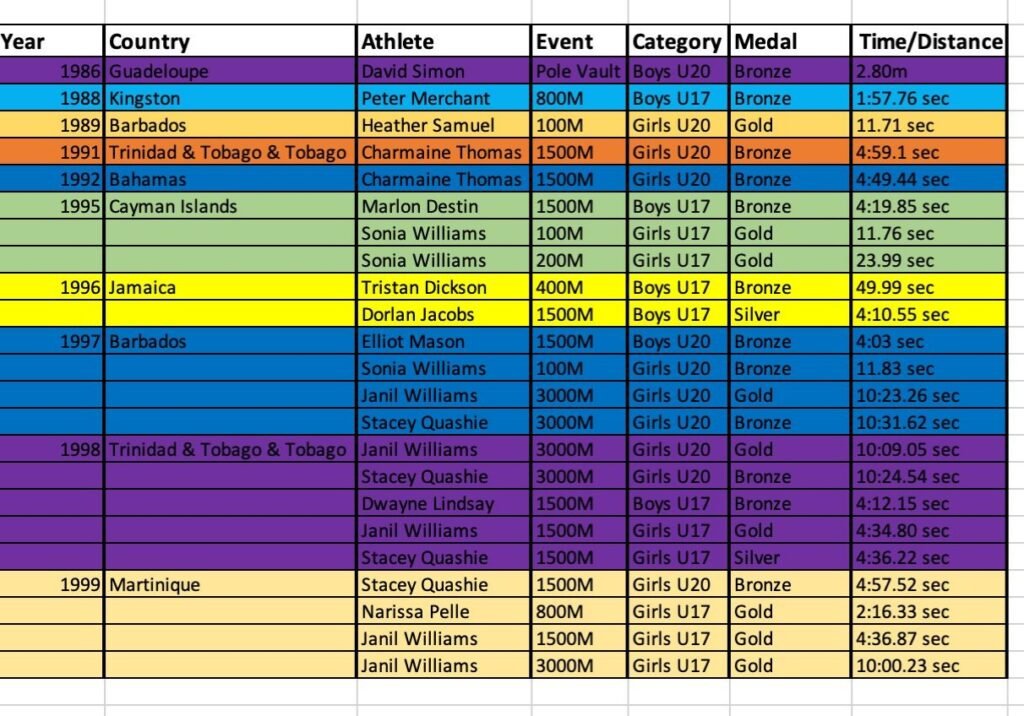
Then came the protest. Team Jamaica challenged the result, and what followed blurred the line between outcome and uncertainty. At the medal ceremony, Samuel was presented with a silver medal. And up to now, she insists in all conversations, ‘I received that silver medal.’
Yet, history has its own way of settling truth. In the record books and within track and field circles, Samuel is recognised as the winner of that race. Recognition lives where official correction did not. It remains one of the most unresolved moments in CARIFTA history. A reminder that performance is permanent, even when outcomes are disputed.
The Shift: When Speed Took Over
By the 1990s, the programme began to change.Sonia Williams brought confidence and presence to sprinting, while Janil Williams dominated middle-distance events during one of the most successful eras in CARIFTA history from 1997 to 2003.
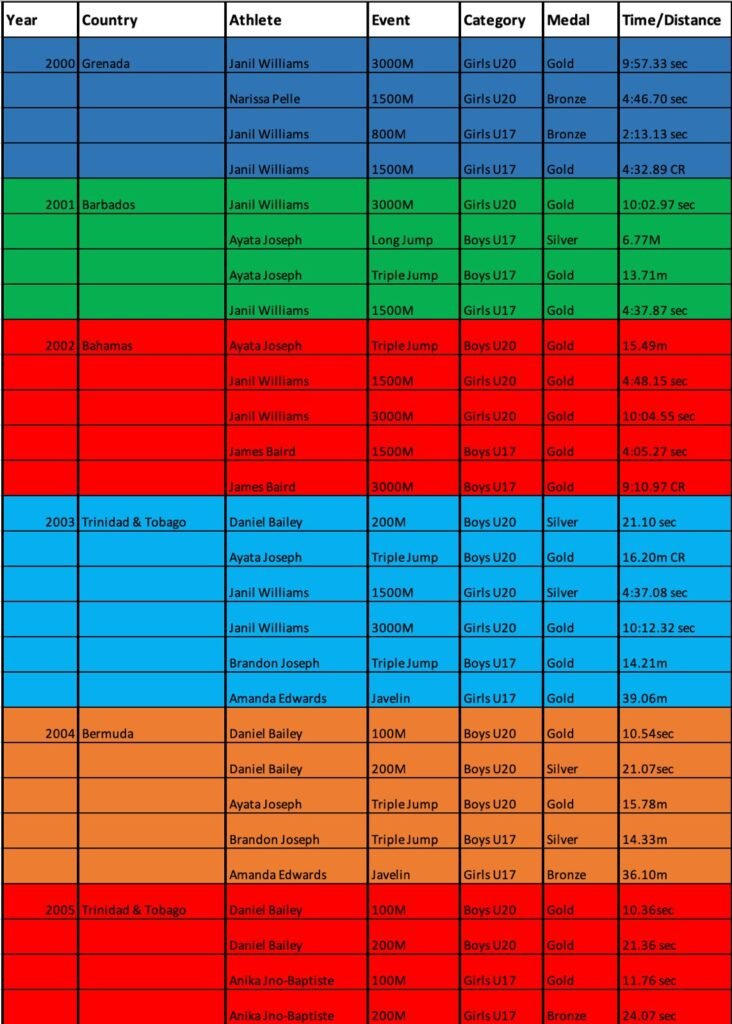
Janil’s mastery of the 800m, 1500m, and 3000m set a new standard of consistency for Antigua and Barbuda. Her CARIFTA 14 medal count comprises 12 golds, 1 silver, and 1 bronze. She remains a well-known figure in CARIFTA discussions across the region.
The sprint pivot came in the early 2000s. With the emergence of Daniel Bailey, sprinting was no longer just developing; it arrived. His performances signaled a philosophical shift. His rise to international prominence, including a World Indoor Championship title in the 60 meters, placed Antigua and Barbuda firmly on the global athletics map. His presence in elite sprint finals brought visibility and inspiration. For many young athletes watching from home, Bailey made the pathway feel real. Antigua and Barbuda was no longer just competitive in the field. It was becoming dangerous on the track.
At the same time, the field events did not disappear. Athletes like Brandon Joseph and Ayata Joseph in the triple jump, along with Amanda Edwards in the javelin, ensured that the programme retained its original strength even as it expanded.
Sustaining Through Challenging Times
From roughly 2010 to 2021, the programme entered a less visible phase.
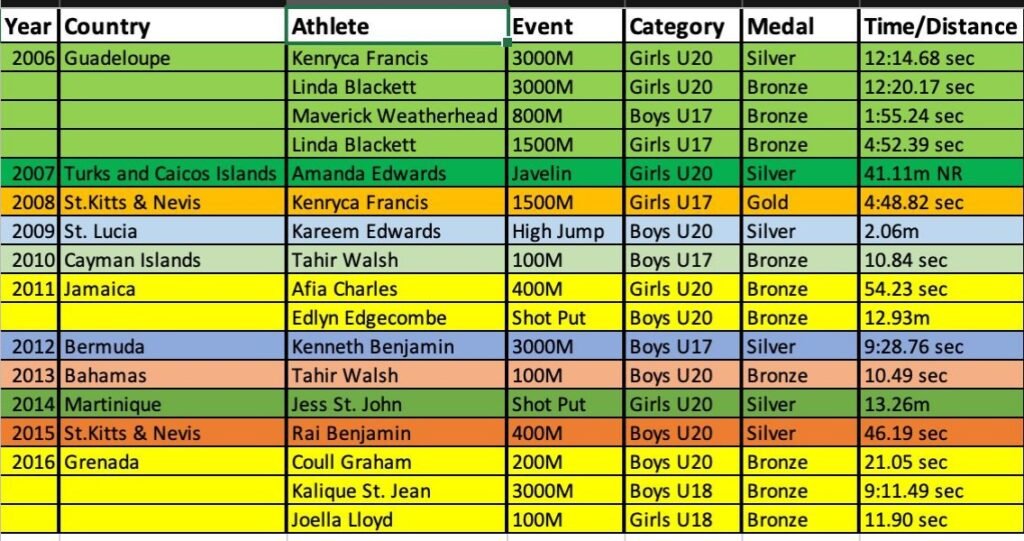
This was not a complete absence of performance, but rather a period where podium dominance became less consistent. Athletes continued to compete, and there were respectable finishes, including finals appearances and podium moments, but the sustained presence among the region’s elite was less impactful.
The work continued by the determined few, even in the face of infrastructure challenges and a lack of support at the highest levels. Behind the scenes, development continued, with club systems, some school programmes, and exposure opportunities sustaining the pipeline. The results were not always immediate, but the groundwork was being laid.
For this era, one athlete stood as a bridge, steady, reliable, and globally present: Tahir Walsh, who medaled at the Carifta Games in 2010 and 2013. He then competed internationally in the 100 metres and relays, and representing Antigua and Barbuda at the Olympic level, Walsh ensured that the country remained visible on the global stage. His career has been defined not by singular moments but by sustained contribution, holding the line during a period of transition.
Global Echoes, Untapped Potential
No modern discussion of Antiguan athletics is complete without acknowledging Rai Benjamin.
Benjamin’s connection to CARIFTA is real. In 2015, he captured silver in the 400 metres, offering an early signal of world-class ability. That signal would later be amplified on the global stage. He would go on to become one of the world’s elite 400m hurdlers, representing the United States at the highest level, including Olympic competition, and ranking among the fastest ever in the event.
His story, however, exists in a complex space. He is not a representative of Antigua and Barbuda internationally, yet his roots are undeniable. His journey highlights both the depth of talent within the island and the importance of systems that can fully harness it.
In many ways, Benjamin represents both a point of pride and a quiet question: what could be, and what must still be built.
The Reawakening: A New Generation Arrives
Now, the new Carifta generation is on the track.
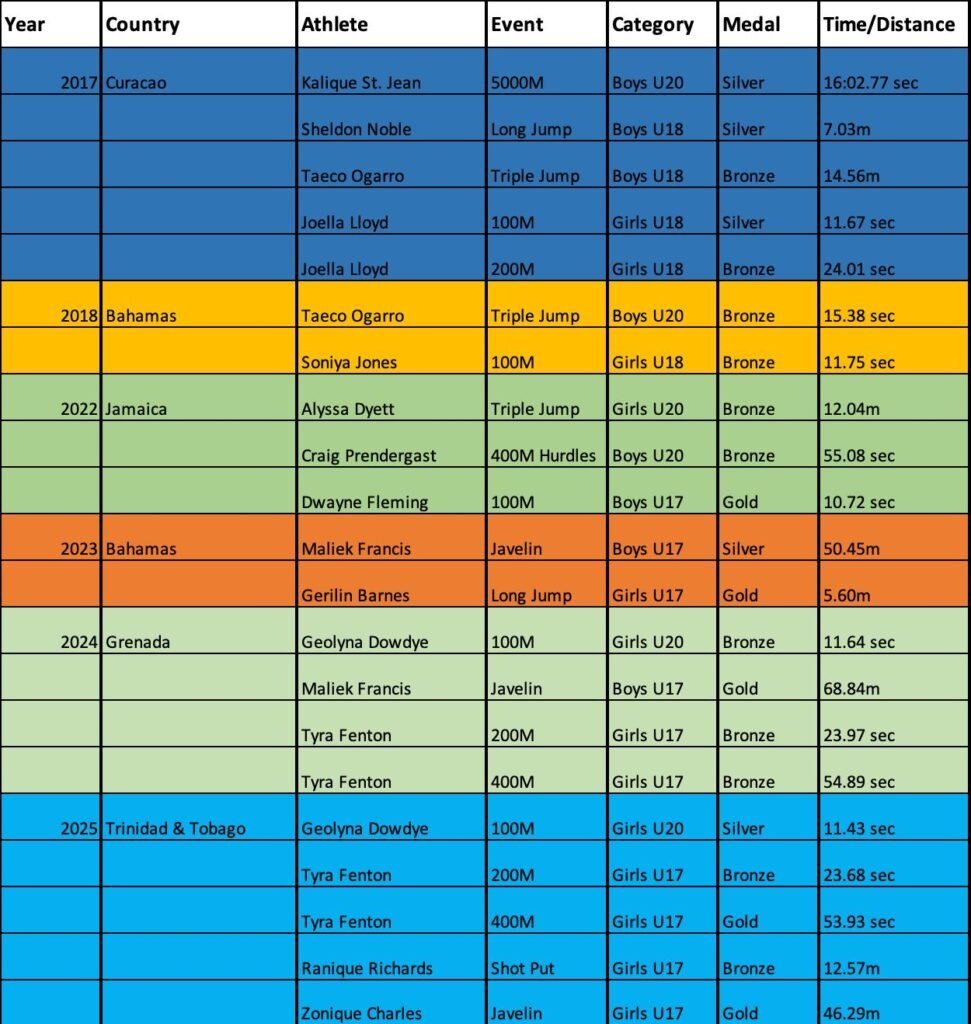
Athletes like Geolyna Dowdye, Maliek Francis, and Tyra Fenton are not emerging in isolation; they are part of a renewed wave. Their performances span sprints, throws, and jumps, signaling a return to balance, but with a sharper competitive edge.
They are following a pathway that Joella Lloyd has already proven. A multiple CARIFTA medallist and national record holder at the 100m and 200m, Lloyd successfully transitioned from the junior ranks to senior international competition, earning recognition for her performances on the collegiate and global stages. Her journey reinforces an important shift within the programme, not just producing CARIFTA medallists, but developing athletes capable of sustaining success beyond it.
And then came a moment that reminded the region that Antigua and Barbuda’s sprinting tradition is never too far from resurgence. In 2022, Dwayne Fleming dashed to gold in the Boys Under-17 100 metres. It was a breakthrough performance that carried both personal triumph and national significance. His victory marked the country’s first 100m gold at CARIFTA since Bailey’s triumph in 2004.
This generation competes with a different posture and stronger national support, though much more is still needed.
More Than Medals

The 116 medals tell one story. But the deeper truth is this: Antigua and Barbuda has learned how to evolve. From field-event specialists to sprint contenders, from dominance to rebuilding, and now toward resurgence, the programme has never stood still.
And that is why, at CARIFTA Athletics, Antigua and Barbuda is never just another team on the start list. It is a nation with memory. With scars. With proof.
And with just enough history to remind the rest of the Caribbean: You ignore us at your own risk.