

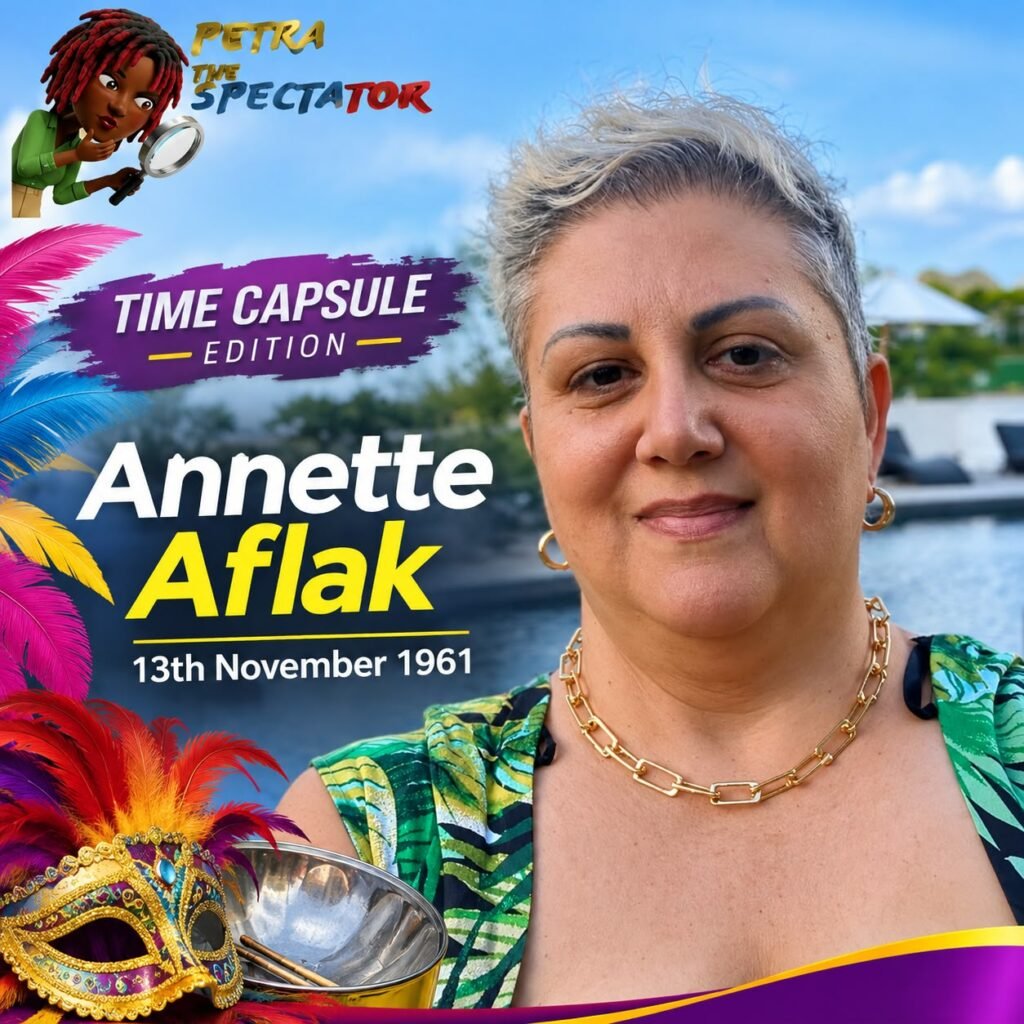
November 13, 1961 – Annette Aflak was born to Antoine Aflak of Lebanon and Lolita Aflak of Antigua. The family initially lived on Market Street before relocating first to High Street and then to Crosbies.
She fondly recalls her childhood in the city, particularly the activity along Market Street, which she enjoyed observing from the windows of her family home. Although not permitted to attend Carnival as a young child, she enjoyed a privileged vantage point as the colourful displays of mas, John (Jam) Bulls and steelbands passed her home. She also looked forward to Sunday evenings when the Salvation Army brought the corner of Nevis Street alive with music.
Those early experiences would prove significant. The little girl watching the Carnival spectacle from her window would eventually become one of the people responsible for organising and transforming the national festival.
It is a connection that runs through much of Annette Aflak’s professional journey, one characterised by creativity, attention to detail, institutional development and a commitment to getting things done.
Finding Her Professional Direction
Annette began her education at Miss Walter’s Preschool before moving on to Christ the King High School.
Following graduation, she travelled to Canada, where she earned a bachelor’s degree in marketing and management from St. Mary’s University in Halifax.
Initially, she had intended to pursue accounting, but soon recognised that the profession did not suit her personality. “I told myself you’re not going back to Antigua to sit behind a desk all day,” she recalls. Marketing, with its opportunities for creativity, interaction and engagement, offered a much better fit.
Upon returning home, Annette assisted in the family business, Lolita’s, before securing her first professional contract, working on an inflight magazine for American Airlines.
Annette continued applying for permanent employment in both the public and private sectors. In June 1984, she joined the government service within the Ministry of Trade, Economic Development, Tourism and Energy. The appointment laid the foundation for a career spanning several important areas of national development.
Learning the Business of Government
Two senior political figures played important roles in Annette’s early professional development: then Minister of Trade Hugh Marshall and Deputy Prime Minister Lester Bird. Both recognised her potential and encouraged her professional growth.
Barely into the civil service, she was sent to her first Organisation of Eastern Caribbean States (OECS) meeting at the insistence of Minister Marshall, who believed young officers needed exposure to the workings of regional institutions if they were to understand and eventually contribute meaningfully to the system. It was an important lesson in professional development through practical experience.
Before long, Annette was attending CARICOM and OECS meetings as a senior technical officer and, on occasion, participating in meetings of the Organization of American States.
Her responsibilities also brought her into direct contact with small business development. She assisted entrepreneurs in navigating the processes necessary to establish their businesses and recalls the satisfaction of seeing some of those enterprises continuing to operate many years later. For her, their survival was evidence that the guidance and support provided during those early years had made a difference.
Annette also served as the first Marketing Manager of a reactivated Industrial Development Board. When the Board was disbanded shortly thereafter, she made a personal decision to step away from the system for a year to focus on motherhood.
A Return to Tourism and a New Cultural Assignment
In 1992, Annette returned to the public service, this time within the Department of Tourism. It was a move that would eventually bring together her professional training in marketing, her interest in people and her appreciation for the cultural expressions she had enjoyed from childhood.
In 1998, she was selected as the Department’s representative on the Carnival Development Committee, an assignment that marked a turning point in her career.
Annette was instrumental in establishing the first Carnival website and introducing marketing approaches that departed from the festival’s traditional promotional practices. Her work attracted attention, and the following year she was second to serve as Coordinator of Carnival.
That appointment began a period of increasingly significant responsibilities in administering and developing the national festival. After three years in that position, she moved up to Deputy Chairman of Carnival, and into an advisory role supporting the minister responsible for culture, festivals and sports.
Her association with Carnival administration continued through subsequent years, during which she contributed to initiatives aimed at improving the festival’s organisation, marketing and institutional framework.
Reimagining Carnival
Her tenure also brought innovations to the festival’s program, including the introduction of the Village Queen Pageant, which became an exciting and popular feature of Antigua’s Carnival for many years.
The pageant added another platform for young women representing communities across Antigua and Barbuda, broadening participation in the national festival and strengthening the connection between Carnival and village life.
Another contribution she recalls with satisfaction was helping revive the National Panorama competition, including the decision to allow steelbands to perform tunes of their choice rather than requiring a traditional test piece. “It brought new life to the competition,” she reflects. “We wanted to make people fall in love with pan again.”
Together, these initiatives reflected an approach to cultural development that valued innovation, community participation and renewed audience engagement, while preserving the traditions that made Carnival an important expression of national identity.
For the child who once watched steelbands and masqueraders pass along Market Street, helping to shape the festival she had admired from her window brought her journey full circle.
Strengthening the institutions behind Carnival was another part of Annette’s involvement, beyond the coordination of events. She sought to transform the Carnival Committee into a more formal board structure under a proposed Festivals Commission, strengthening the institutional arrangements supporting the festival.
At the time of the original interview in October 2023, that vision had not fully materialised, but Annette remained hopeful that a stronger institutional framework would emerge. Since then, the position has changed: she now serves as a director of the Antigua and Barbuda Festivals Commission, a statutory authority with a modern institutional framework managing the country’s premier national festival.
Beyond Carnival: Tourism, Protocol and International Events
Following the 2014 Carnival celebrations, Annette returned to her substantive position in the Department of Tourism, where she continued her work in marketing, events and protocol.
Across her career, Annette contributed to major national and international engagements. These included the 2007 Cricket World Cup and, later, the 2024 Fourth International Conference on Small Island Developing States (SIDS4).
Such assignments required coordination across government departments, international organisations, service providers and other stakeholders. Hospitality, protocol and logistics were central to that work, helping the country deliver an experience consistent with its international reputation.
For Annette, successful event management was not simply about what happened on the stage or what visitors saw. It depended equally on the preparation, coordination, and attention to detail behind the scenes.
Answering the Call of Culture Again
In 2019, Annette was again called upon to serve in cultural administration. Following the announcement that Antigua and Barbuda would host the regional cultural festival, Vaughn Walter took up responsibilities as Director of CARIFESTA, and she was asked to fill the vacancy he left as Director of Culture. After Walter’s passing, she later became CARIFESTA Director.
It was another example of a recurring pattern in her career: being called upon to assume responsibilities that required experience, adaptability, and the ability to coordinate complex assignments.
Her involvement in cultural administration continued to demonstrate the importance of the institutional knowledge accumulated over decades of public service.
A Career That Continued to Answer the Call
Annette was approaching retirement when her story was first documented, yet her professional calendar remained full of assignments. At that time, one of the major undertakings on the horizon was the 2026 Commonwealth Heads of Government Meeting (CHOGM), for which she was identified as part of the original organising team.
With Antigua and Barbuda having since hosted CHOGM, Annette’s assignment now forms part of the major international engagements that marked the later years of her public-service career. Her involvement illustrates the continuing demand for experienced professionals to manage the many moving parts of events that place Antigua and Barbuda on the international stage.
From the Cricket World Cup to SIDS4 and preparations for CHOGM, Annette’s professional journey reflects the growing demands placed on a small island state hosting events of regional and global importance.
The Standards Behind the Work
For all her accomplishments, Annette has never been particularly interested in public recognition. “No awards, just thank you,” she says. It is a modest assessment of a career that has influenced how national events are planned, marketed, and delivered.
Perhaps one of the more revealing measures of that influence is the standard associated with her name among younger officers in the festivals office. “That’s not how Annette would have done it.” The remark speaks to the expectations she established through her work, particularly her insistence on preparation, attention to detail, and professional execution.
Her hands-on approach to leadership has also been a defining characteristic. Annette believes that effective leaders must understand the full scope of the operations they supervise and be capable of functioning in different capacities when circumstances require.
For her, that understanding is particularly important in delivering good customer service, which she regards as an essential component of national development.
Her advice to younger professionals entering the sector is equally practical: “Go in with the mindset that you are going to make change, no matter how small, and if no one gives you work, create work for yourself.” It is advice grounded in her own experience of identifying opportunities, accepting responsibilities and finding ways to improve the systems in which she worked.
Time Capsule Reflection – The Value of Those Behind the Scenes
 National development is often told through the stories of political leaders, major investments and landmark events. Yet behind many of those achievements are professionals whose contributions are less visible but no less important.
Annette Aflak’s career offers a window into that dimension of nation-building.
Her work has crossed several important areas of public life. Supporting small businesses and representing Antigua and Barbuda at regional meetings connected her to economic and regional development. Introducing the Village Queen Pageant, revitalising Panorama and modernising Carnival marketing brought her into cultural life, while coordinating international events extended that work to the international stage.
The journey from her Market Street window to Carnival administration captures that connection between personal experience and public service. The sounds of steelbands and the colour of the masquerade that fascinated Annette as a child eventually became part of her professional responsibility.
Her career also demonstrates the importance of mentorship, institutional memory and the willingness to expose younger officers to opportunities that allow them to grow. Just as Hugh Marshall and Lester Bird recognised her potential early in her career, Annette has sought to leave behind standards and lessons for those following in her footsteps.
As Antigua and Barbuda continues to expand its presence as a destination for international conferences, cultural celebrations and major sporting events, the experience accumulated by professionals such as Annette remains an important national resource.
On November 13, we celebrate Annette Aflak, whose journey from the windows of Market Street to the planning rooms of major national and international events reminds us that service to country is often measured not by the spotlight one occupies, but by the standards one establishes and the opportunities one creates for others.