
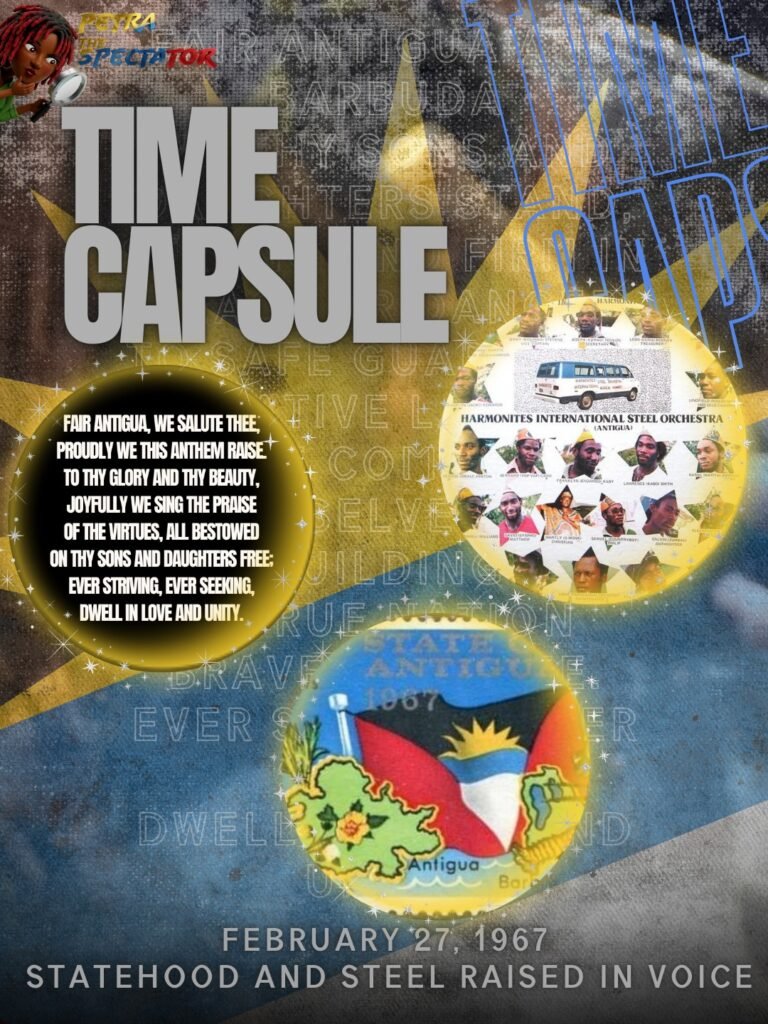
February 27, 1967, stands as one of those hinge moments in the story of Antigua and Barbuda.
On that day, the nation took a decisive constitutional step toward self-governance, while in the cultural space, a group of determined young pannists laid the foundation for what would become one of the country’s most enduring steel orchestras.
Two developments, one national awakening.
1967: The Political Turning Point
On February 27, 1967, Antigua achieved Statehood in Association with Britain under the West Indies Act of that same year. The new constitutional arrangement granted Antigua full internal self-government while Britain retained responsibility for defence and foreign affairs.
The new status covered Antigua, Barbuda, and Redonda, and would remain in effect until November 1, 1981, when the nation achieved full Independence.
Under the leadership of Premier V. C. Bird, the Associated Statehood period accelerated the development of local political institutions and expanded the space for national decision-making.
Economically, the late 1960s marked the early pivot away from the traditional sugar economy toward tourism and service industries.
Politically and socially, the period opened the door to wider democratic expression, including the formalisation of the Antigua Workers’ Union later that same year.
Nationhood in Symbol and Song
The constitutional shift of 1967 was matched by powerful national symbols.
On February 27, 1967, the flag of Antigua and Barbuda was first officially raised, marking the twin-island nation’s new status as an Associated State with full internal autonomy. The now-iconic design was created in 1966 by local teacher and artist Sir Reginald Samuel, whose rising sun motif would become one of the most recognisable national emblems in the Caribbean.
The period also gave voice to national identity through music. “Fair Antigua, We Salute Thee,” written by Novelle Richards and composed by Walter Garnet Picart Chambers, was adopted in 1967 as the country’s de facto national anthem while Antigua and Barbuda remained a British colony.
Together, the flag, the anthem, and the new constitutional status signalled a people stepping more confidently into self-definition.
And while constitutional machinery was being recalibrated in Government House and Parliament, another transformation was unfolding in a pan yard.
The Birth of Westside Harmonites
Months before Statehood was declared, a quiet but decisive move had already begun.
In September 1966, a group of young members of the Junior Hellsgate Steel Band faced a practical problem: the pan house they shared with the senior Hellsgate orchestra had become too small. Storage was tight. Practice times were clashing. And the ‘Young Turks’ felt that they were being underserved and ignored by the ‘Old Guard’. After all, in their minds, they were equally good and perhaps, in some quarters, better. Under the leadership of the rebel with a cause, Rupert ‘Teela’ Parker, George Weeks, Kenroy Watkins, Luxmore Buckley, Dennis Lashley, Leroy “Jughead” Gordon, Igal Edwards, and Fitzroy Simon packed up their instruments and ambition and moved out.
Their intention was clear: to recruit, to train, and to enter the Panorama Competition in Carnival later that year. At their new home on St. Johns Street, the group attracted attention and a quick following.
High on the to-do list was a new identity, given the consensus that Junior HellsGate would no longer be appropriate. A Community elder, Mr. George Williams, listening to the band, made a simple but powerful observation: the young players blended their music in harmony and suggested a name that would capture that quality: Harmonites.
A constitution was drafted. The organisation was formalised. And on February 27, 1967, the very day Antigua (Barbuda & Redonda) attained Associated Statehood, Westside Harmonites was officially born, with Rupert “Teela” Parker serving as the first Captain and Arranger.
History has a quiet sense of timing.
From Young Rebels to Panorama Powerhouse
From those eight pioneers, Westside Harmonites grew steadily, recruiting and training new members and embedding itself in the cultural heartbeat of St. John’s.
Teela recalls that, among their very first outing, there was no space allocated for them to set up to perform, save for vendor Baby Quash, a respected Point woman, who ensured that space was made alongside where she was plying her trade. That performance cemented their standing with the wider community, allowing them to secure more resources and play gigs.
Over the decades, the Harmonites Steel Orchestra would establish itself as one of Antigua and Barbuda’s premier steel bands, capturing eight National Panorama titles in 1968, 1969, 1971, 1972, 1974, 1985, 2001, and 2004.
Leadership continuity also became part of its legacy, with Simon ‘Kamau’ Toulon emerging as the band’s longest-serving Captain.
The band remains active today under the captaincy of Alston Davis.
What began as a spatial necessity became a cultural institution.
One Date, Two Nation-Building Stories
The coincidence is striking but not accidental in meaning. In 1967, Antigua and Barbuda was learning to govern itself internally. At the same time, young cultural practitioners were learning to organise themselves musically and institutionally. Both developments reflected the same national impulse of greater self-definition, stronger local ownership and confidence in homegrown capacity
Statehood expanded the domestic political space while Harmonites expanded the domestic cultural space. Together, they illustrate the diversity that is a critical success factor in solid, high-quality nation-building.
Time Capsule Reflection
February 27 reminds us that national progress is never confined to Parliament chambers or constitutional documents. Sometimes it sounds like steel.
From the corridors of emerging self-government to the pan yard on in The Point on Lower St. John’s Street, 1967 was a year when Antigua and Barbuda was learning, in multiple ways, to stand more firmly on its own feet.
Political maturity and cultural confidence were rising together.
And nearly six decades later, both the Statehood milestone and Harmonites International Steel Orchestra remain powerful symbols of a country finding its voice.
Some dates do more than mark time; they mark transition, and in the words of the motto of the men and women of Harmonites, ‘Fortune Favours the Brave’.